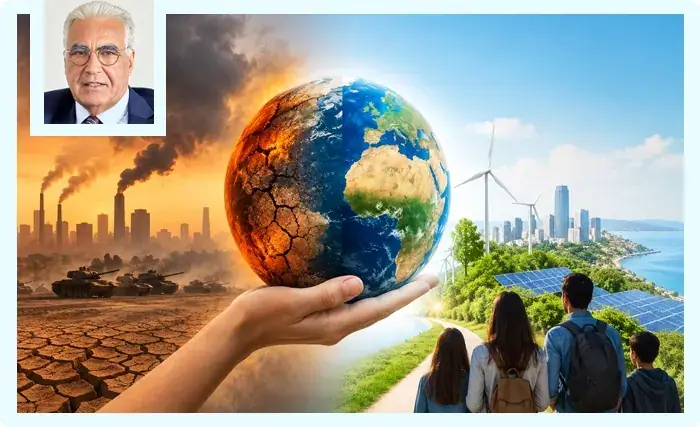
In a recent statement, Tunisian expert Samir Allal emphasized the existential threat posed by climate change to the planet. He noted that the issue at hand is not only the depletion of natural resources but also the potential for human extinction due to the reckless actions of global powers. Allal highlighted the changing climate and the inability to control it, leading to geopolitical insecurity and a reevaluation of the global order.
Allal pointed out that the current situation is marked by a crisis of intelligibility, where traditional frameworks are unable to make sense of the reality. He stressed that the ecological and energy transition is occurring simultaneously with an ultra-liberal revolution led by the world's richest individuals. This has resulted in resistance from fossil fuel majors and consumer countries, which may lead to future convulsions at upcoming COP meetings.
The expert noted that while the ecological transition has not disappeared from discourse, it has been metamorphosed into various forms, including industrial war, neo-Malthusianism, and survivalism. He questioned the type of world that should be aimed for and the values that should guide the transition, including liberty, sobriety, climate justice, public power, security, autonomy, and protection of the living.
Allal highlighted that many countries were already vulnerable before the current geopolitical upheaval, and those that have not made strategic progress in their transition risk economic and technological decline, as well as increased dependence on fossil fuels. He emphasized that trajectories for a decarbonized world exist, but countries in development must make strong choices to achieve this goal.
The expert criticized the current situation, where the world is heavily rearming and decarbonizing insufficiently, leading to a lack of an ordered and gradual transition. He analyzed that the climate disaster is irreversible and that unregulated artificial intelligence may have devastating consequences. Allal described the digital capitalism system as closed and controlled by a small group of ultra-rich individuals who maintain monopolies and stifle innovation.
Allal emphasized that the transition to a decarbonized economy requires collective organization, which can only be orchestrated by the state. He highlighted the enormous stakes, including the elimination of fossil fuels, transformation of agriculture, and redefinition of urbanization. However, these structural changes have not been reflected in public policies or budgetary decisions, leading to insufficient reductions in greenhouse gas emissions.
The expert concluded that it is not too late to decarbonize the economy and stop global warming, despite the challenges and costs involved. He stressed that the transition must be accelerated to combat inequalities, ecologize society, and preserve the freedom of action for current and future generations. Allal emphasized that international cooperation is essential to address the global threat of climate change and prevent the negative consequences of "carbon leakage."
Key points
- The ecological transition requires a collective organization led by the state to achieve a decarbonized economy.
- The current situation is marked by a crisis of intelligibility, where traditional frameworks are unable to make sense of the reality.
- The transition to a decarbonized economy must be accelerated to combat inequalities and preserve the freedom of action for current and future generations.