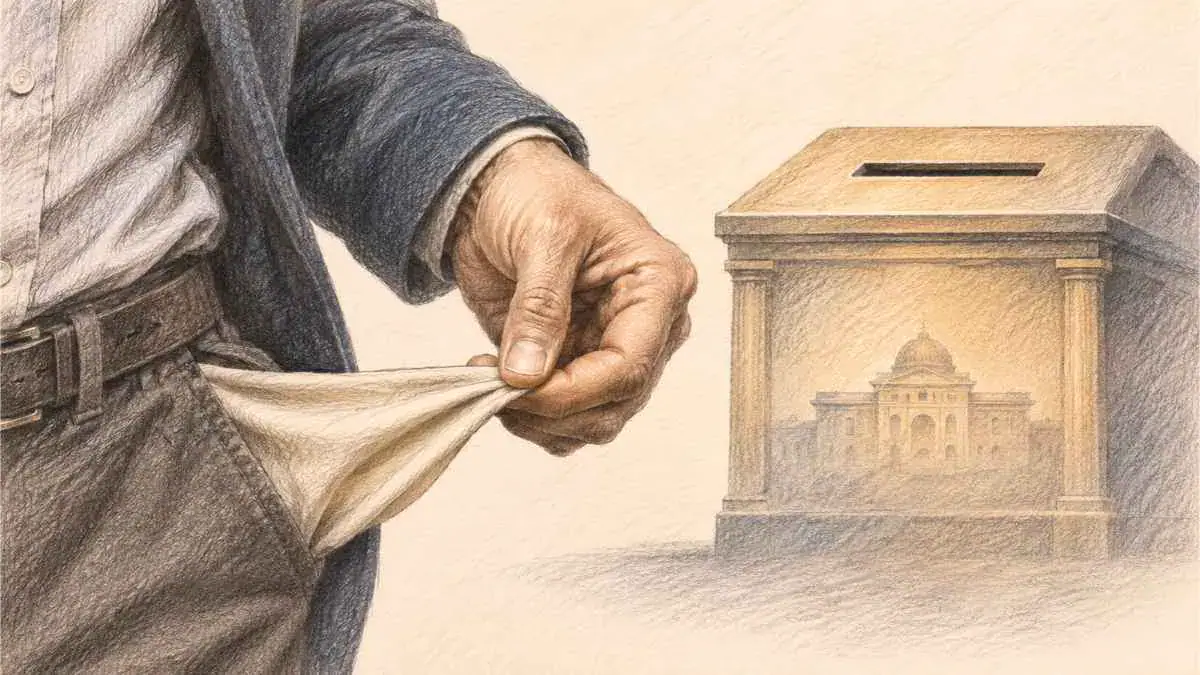
Tunisian economist and academic Ridha Chkoundali has spoken out against the government's recent appeal for citizens to dip into their savings to support the state's finances. In a Facebook post on November 14, Chkoundali expressed concern that the government's approach oversimplifies the country's economic crisis. He argues that increasing fiscal pressure on citizens will not necessarily lead to higher state revenues and may instead stifle economic activity and investment.
Chkoundali notes that the savings rate of Tunisian households has significantly declined, reaching only 3% in 2025, down from 8.6% in 2021. He attributes this decline to rising food inflation and increasing prices of essential goods. The economist questions whether citizens have any savings left to tap into, given that many families are already struggling to cover their basic needs. He also asks whether the government is aware of the proportion of household income devoted to food and the number of families that spend their entire income or go into debt just to meet essential expenses.
The economist criticizes the government for not providing a clear explanation of how it has utilized previously mobilized resources and funds borrowed from the private sector. He cites estimates that the Central Bank has injected approximately 25 billion dinars over three years to meet the state's financing needs. Chkoundali asks whether this exceptional mobilization has led to tangible improvements in healthcare, social services, infrastructure, or public transportation.
Chkoundali argues that the government's discourse unfairly places the responsibility for providing new resources on citizens, investors, and the private sector, without offering convincing explanations for the use of existing resources or a clear vision for reforming public finance imbalances. He advocates for a shift in approach, focusing on reforms that would encourage investment, growth, and job creation, rather than simply seeking to extract more money from citizens.
The economist emphasizes that taxation should not be an end in itself but rather a tool for financing public services and development. He warns that relying solely on fiscal pressure to address the state's deficits will not create a strong state and may even undermine economic growth. Chkoundali calls for a more comprehensive approach that addresses the root causes of the economic crisis and promotes trust in investment and savings.
Chkoundali urges the government to present a clear assessment of the reforms implemented by the Finance Ministry and the government as a whole. He stresses that citizens are not merely a budget reserve and that the private sector should not be seen as a machine for financing public spending. The economist argues that growth, production, and investment are essential for building a strong state, rather than simply increasing tax revenues.
The debate highlights the need for a more nuanced discussion on Tunisia's economic challenges and the role of fiscal policy in addressing them. As the government seeks to address its financing needs, it faces pressure to adopt a more comprehensive approach that balances the need for revenue with the need to promote economic growth and investment. The issue remains a pressing concern for Tunisia's economic future.
Key points
- The Tunisian government's call for citizens to tap into their savings to support state finances has been criticized by economist Ridha Chkoundali.
- The savings rate of Tunisian households has significantly declined, reaching only 3% in 2025, down from 8.6% in 2021.
- Chkoundali argues that taxation should not be an end in itself but rather a tool for financing public services and development.