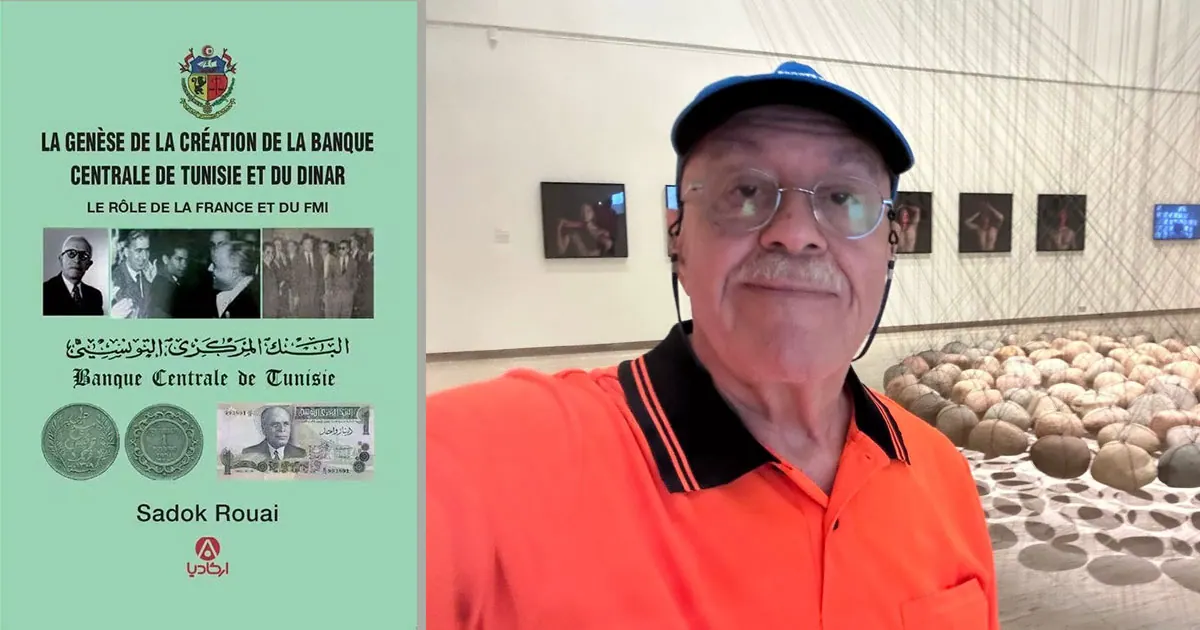
A new book by Tunisian economist Sadok Rouai, titled "La genèse de la création de la Banque centrale de Tunisie et du dinar – Le rôle de la France et du FMI," has been published by Arcadia in Tunis. The book examines the creation of the Central Bank of Tunisia (BCT) and the national currency, the Tunisian dinar. Rouai, an expert with a background in economics and banking, offers a fresh perspective on this pivotal period in Tunisia's financial history.
The book delves into the complex negotiations that accompanied the construction of Tunisia's monetary sovereignty. Rouai sheds light on the pressures exerted by France and the technical support provided by the International Monetary Fund (IMF) in implementing monetary reforms. By drawing on archives and financial reconstructions, the book aims to provide a new understanding of the origins of the Tunisian dinar and the BCT.
Sadok Rouai's career has spanned various roles in Tunisian and international financial institutions. He began his career at the BCT, where he worked in the departments of studies, international relations, and banking supervision. In 1987, he joined the IMF, where he served as a senior advisor to an administrator for over three decades. His experience in these institutions informs his latest work.
The book's publication date coincides with the 50th anniversary of the BCT's establishment. Rouai's work provides a detailed account of the events leading up to the creation of the BCT and the Tunisian dinar. His analysis highlights the challenges and negotiations that shaped Tunisia's monetary sovereignty.
The author argues that the creation of the BCT and the dinar was a gradual process, influenced by various factors and stakeholders. Rouai's book offers a nuanced understanding of this period, moving beyond the simplistic narrative often referred to as the "battle of the dinar." The book is a valuable contribution to the history of Tunisia's financial development.
Sadok Rouai's publication is a significant addition to the field of economic history, particularly in the context of Tunisia's development. The book is expected to interest scholars, policymakers, and anyone seeking to understand the evolution of Tunisia's financial sector. By examining the country's monetary sovereignty, Rouai provides insights into the complex relationships between Tunisia, France, and the IMF.
The book's release marks a notable event in Tunisia's cultural and economic landscape. As the country continues to navigate its economic challenges, Rouai's work serves as a reminder of the importance of understanding the historical context of Tunisia's financial institutions. The book is a testament to the author's expertise and dedication to shedding light on Tunisia's economic history.
Key points
- The book provides a fresh perspective on the creation of the Central Bank of Tunisia and the Tunisian dinar.
- Sadok Rouai's work highlights the complex negotiations and pressures that shaped Tunisia's monetary sovereignty.
- The book offers a nuanced understanding of the evolution of Tunisia's financial sector.