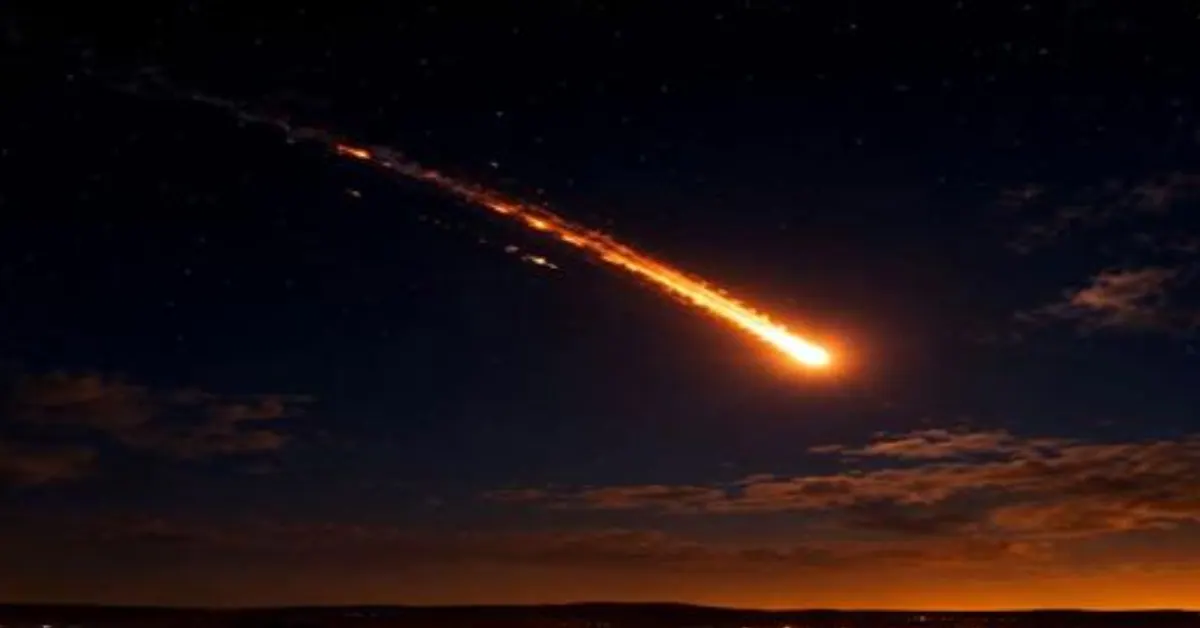
The Tunisian Astronomical Society has shed light on the recent "fireball" phenomenon that sparked curiosity and concern across parts of Tunisia and Libya. According to Hicham Ben Yahya, deputy head of the society, the spectacle involved a relatively large meteorite, estimated to be between half a meter to two meters in diameter, which entered the Earth's atmosphere and burned up due to intense friction. This resulted in the formation of a bright "fireball" and a luminous flash that lasted longer than typical shooting stars.
The high-speed meteorite generated a powerful shockwave and sonic booms, causing doors and windows to shake in some areas before disintegrating into smaller fragments. Initial data suggested that the meteorite might have fallen in the Gulf of Gabes, near the island of Djerba, but more recent information points to a possible landing in the sea off the Libyan coast, specifically near the capital Tripoli. Small debris may have scattered during the disintegration process.
Ben Yahya speculated that the meteorite could be a "chondrite," one of the oldest types of stony meteorites in the solar system, dating back 4.5 to 5 billion years. This would make it a significant find for geological and astronomical research laboratories. The society's findings highlight the importance of precise tracking and monitoring of celestial events.
The Tunisian Astronomical Society is advocating for the establishment of a specialized monitoring and observation system, utilizing internet-linked cameras to accurately track the paths of meteorites and determine their impact sites. According to Ben Yahya, such a system would not require substantial funding and could help transition from relying on eyewitness accounts to precise scientific observation of astronomical phenomena.
The recent event has sparked interest in the field of astronomy in Tunisia, with many citizens eager to learn more about celestial occurrences. The Tunisian Astronomical Society is working to raise awareness and promote scientific understanding of the universe. By investing in monitoring technology, the society aims to improve its ability to study and analyze astronomical events.
Ben Yahya made the statements during an interview on the radio program "In 60 Minutes" on Diwan FM. His comments provided insight into the nature of the "fireball" and its possible origin. The society's research and findings are expected to contribute to a better understanding of meteorites and their characteristics.
The incident has highlighted the need for enhanced astronomical monitoring capabilities in the region. The Tunisian Astronomical Society's efforts to promote scientific research and public awareness are seen as steps towards achieving this goal. Further details about the meteorite's composition and origin are expected to be revealed as research continues.
Key points
- The meteorite is believed to be a "chondrite," a type of stony meteorite that is one of the oldest in the solar system.