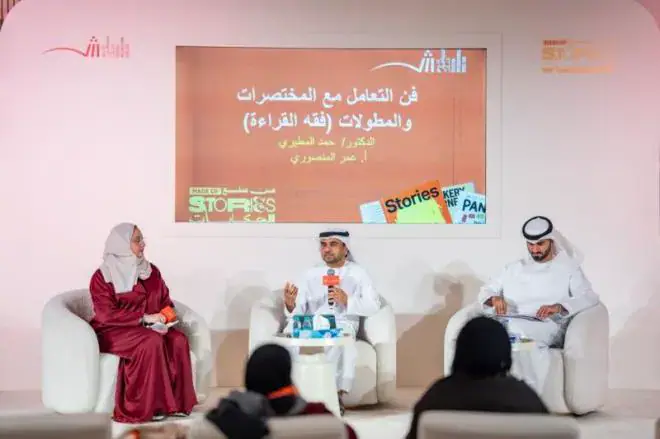
Tunisian academics have emphasized that the quality of reading is measured by the level of comprehension and knowledge acquired, rather than the number of books read or pages turned. This was stated during a symposium held as part of the Sharjah International Book Fair 2026, titled "The Art of Dealing with Abbreviations and Long Texts (The Jurisprudence of Reading)". The symposium featured academics Hamad Al-Mutairi and Omar Al-Mansouri, who discussed mechanisms for dealing with scientific content and common methodological errors in reading.
The academics stressed the importance of adopting a gradual and sound methodology in scientific and specialized reading, starting with "abbreviations" as a foundation for understanding what is being read, before moving on to "long texts" and encyclopedias that can deepen knowledge and analyze ideas. Dr. Hamad Al-Mutairi, Deputy Chairman of the International Council for Archives (Programs Division), explained that "abbreviations" provide readers and researchers with initial terminological keys to scientific material, while "long texts" are the optimal tool for analyzing contexts, detailing, and comparing different narratives and sources.
Al-Mutairi cited the introduction of Ibn Khaldun and his theories on human civilization and the development of societies, as well as the book "History of Prophets and Kings" by Al-Tabari, as examples of encyclopedias that allow tracking historical dimensions in their entirety. He also emphasized that understanding historical or cognitive events requires going beyond mere observation of their occurrence, and instead, involves delving into their causes and backgrounds. Al-Mutairi warned against the dangers of relying solely on digital summaries and content, which can lead to superficiality, and stressed that true specialization requires in-depth knowledge and familiarity with original sources.
Omar Al-Mansouri, an academic and researcher, considered reading to be a vital skill that is acquired through continuous practice and training, likening reading comprehension to physical fitness, which develops gradually. He criticized the phenomenon of "collecting books" and gathering studies and publications without truly understanding their content, or rushing to read a large quantity of pages without achieving any real knowledge benefit. Al-Mansouri recommended that readers and researchers take notes on important ideas and use indexes as a roadmap to reach required issues.
Al-Mansouri also suggested starting with titles that match the reader's knowledge level and explaining difficult terms before moving on to reading more complex references. Regarding technological advancements and digital transformations, Al-Mansouri believed that "paper books remain the ideal container for major specialized references, as they facilitate margin notes and reviews", while digital media are practical and fast tools that help in searching for specific information.
The academics concluded that family and educational institutions have a fundamental role in establishing an environment that encourages reading by stimulating young people to read through the stories of scholars and innovators, and that curricula should be adapted to combine paper books and digital media to encourage students to read. They also emphasized that artificial intelligence technologies represent a means of assisting researchers in accessing information, provided that research results are verified and checked by referring to original references.
The symposium highlighted the importance of balancing the use of technology with traditional reading methods, and encouraging a love of reading among new generations. The academics' recommendations aimed at improving reading habits and promoting a culture of knowledge and understanding.
Key points
- Quality of reading is measured by comprehension, not quantity of books read.
- AI tools should supplement, not replace, original sources.
- A gradual and sound methodology is necessary for effective scientific and specialized reading.