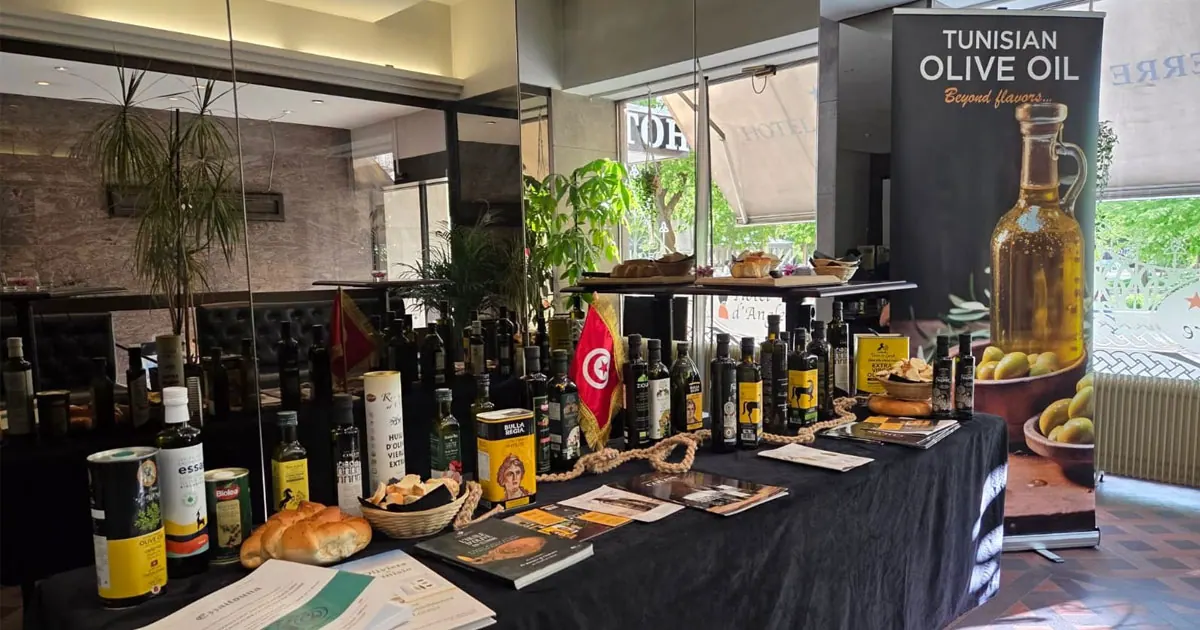
Tunisia's organic olive oil exports have seen significant growth, with 45,550.6 tonnes sold between January and August 2026, generating 596.8 million dinars ($180.8 million). This represents an 18.5% increase in volume and 19.7% rise in revenue compared to the same period in 2025. The data, released by the Tunisian National Observatory of Agriculture (Onagri), highlights the growing importance of organic olive oil in the country's exports.
The olive oil sector dominates Tunisia's organic product exports, accounting for 87.7% of the total volume and 89.2% of the value. Overall, Tunisia's organic product exports reached 51,924.3 tonnes, valued at 669.2 million dinars ($202.8 million), during the first eight months of 2026. The growth in organic olive oil exports is a positive trend, but the sector's structure remains a concern.
Despite the growth, bulk sales continue to dominate Tunisia's olive oil exports. During the 2025-2026 campaign, 49,699.6 tonnes of bulk olive oil were exported, generating around 644 million dinars ($195.2 million). In contrast, packaged olive oil exports were significantly lower, at 3,320.9 tonnes, valued at approximately 55.5 million dinars ($16.8 million). This highlights the need for Tunisia to increase its packaged olive oil exports.
The main markets for Tunisia's organic olive oil are Italy, Spain, the United States, France, and Saudi Arabia. Italy is the largest market, absorbing 39% of the country's organic olive oil exports, followed by Spain (26%), the United States (23%), France (8%), and Saudi Arabia (2%). Tunisia's organic olive oil was exported to 34 countries across five continents by 59 exporters.
Experts stress that increasing the share of organic and packaged olive oil in Tunisia's exports is crucial to better valorize the product. Currently, packaged olive oil accounts for only around 6% of the country's olive oil exports, while bulk sales generate the majority of the revenue. A shift towards more packaged olive oil exports could help Tunisia increase the value of its olive oil sales.
The Tunisian government and industry stakeholders will need to work together to develop strategies that promote the growth of the packaged olive oil sector. This may involve investing in infrastructure, providing support to small-scale producers, and developing marketing campaigns to promote Tunisian olive oil globally.
As the olive oil sector continues to grow, Tunisia must focus on diversifying its exports and increasing the value of its olive oil sales. By boosting organic and packaged olive oil exports, the country can increase its revenue and strengthen its position in the global market.
Key points
- Tunisia's organic olive oil exports grew by 18.5% in volume and 19.7% in revenue between January and August 2026.
- Bulk sales dominate Tunisia's olive oil exports, accounting for around 94% of the total volume.
- Packaged olive oil exports account for only around 6% of Tunisia's olive oil exports.