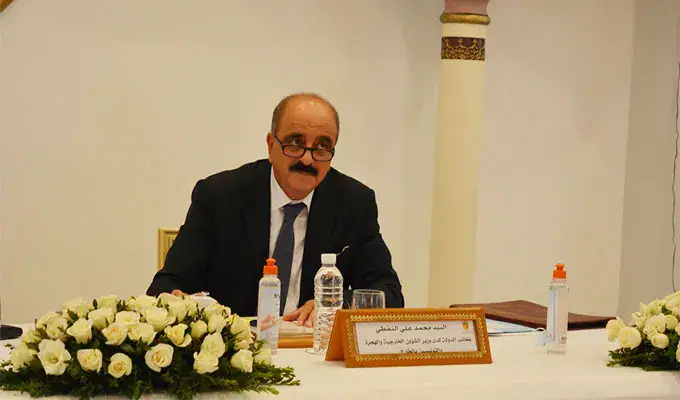
Tunisia's Foreign Minister Mohamed Ali Nafti has reaffirmed the country's commitment to leveraging international partnerships for development, particularly in financing priority projects, attracting investments, and opening new markets for Tunisian businesses. Speaking at a joint plenary session in Parliament on the 2027 budget for his ministry, Nafti highlighted the importance of economic diplomacy despite limited financial resources.
Nafti reported ongoing discussions with the European Union regarding the 2025-2027 financial programming, with Tunisia advocating for increased funding and a revision of the association agreement, while respecting its sovereign economic choices. New agreements and financing have been secured with several partners, including Germany, France, Italy, the Netherlands, Spain, Kuwait, the United Arab Emirates, Japan, and China.
The minister cited several notable agreements, such as the 2025-2027 Tunisia-Italy cooperation program worth €400 million and a Japanese grant of 67 million dinars for a pilot wastewater treatment station. With China, Tunisia is pursuing multiple projects, including the reconstruction of the El Menzah Olympic Stadium, the development of an oncology center in Gabès, and the expansion of the Al-Khawarizmi computing center in Manouba.
Nafti also mentioned ongoing electrical interconnection projects between Tunisia and Italy, as well as a 400 kV interconnection project between Tunisia, Algeria, and Libya. The construction of a 1,400 MW power plant with Algeria is also being considered. On the commercial front, efforts are being made to defend Tunisian business interests abroad and diversify export outlets, particularly for olive oil.
The minister reported that Tunisian exports to sub-Saharan Africa have exceeded 835 million dinars in the first nine months of 2026, compared to 323 million dinars in imports. The goal is to increase Africa's share of Tunisian exports to 5%, leveraging the African Continental Free Trade Area and the Common Market for Eastern and Southern Africa.
Nafti recalled that the previous cooperation framework with the United Nations enabled the mobilization of $661 million, while Tunisia is working to implement a debt-for-climate project initiative. On the diplomatic front, he reaffirmed that Palestine remains a top priority for Tunisia and expressed concern over developments in the Gulf and the Middle East, calling for dialogue to prevent conflict escalation.
Regarding Libya, Nafti reiterated Tunisia's support for an inter-Libyan political solution, free from foreign interference, within the framework of a concertation mechanism with Algeria and Egypt under the auspices of the United Nations. Tunisia, which chairs the Arab League Council at the ministerial level, aims to promote consensus among member states and strengthen coordination within regional and international organizations.
Key points
- Tunisia is pushing for increased EU funding and a revision of its association agreement to support economic development.
- The country has secured new financing agreements with several international partners, including a €400 million program with Italy and a 67 million dinar grant from Japan.
- Tunisia aims to increase its exports to sub-Saharan Africa to 5% of its total exports, leveraging regional trade agreements.