Tunisia is advocating for non-debt climate financing, prioritizing donations to support its climate adaptation projects. This appeal is made in a context marked by complex procedures for accessing climate financing and insufficient funding allocated to climate change adaptation in developing countries. According to the Organisation for Economic Co-operation and Development (OECD), loans still represent 67% of public climate financing provided and mobilized by developed countries.
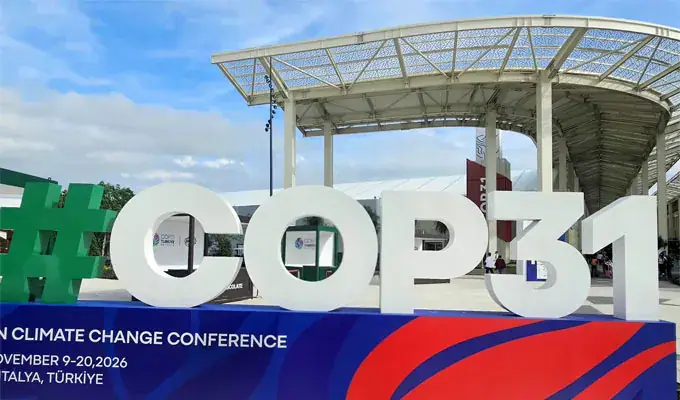
The Tunisian Minister of Environment, Habib Abid, stated that the country is currently focusing on donations, citing a recent example of Dutch support worth €61 million for coastal protection. Abid made these statements in Antalya, Turkey, after a meeting with the Tunisian delegation participating in COP31. He discussed common issues with his African counterparts, including access to climate financing, adaptation methods and techniques, and the energy and ecological transition.
Tunisia has a portfolio of adaptation projects that align with its national priorities, which it defends within negotiation groups, including those representing Africa, Arab countries, and the China+77 group. One of the mentioned projects is the green belt, officially launched in January 2026, which aims to combat desertification. Additionally, the Ministry of Environment is working on the TANIT project, which involves valorizing wastewater for irrigation purposes.
The TANIT project aims to irrigate 12,000 hectares of olive groves and produce fodder. According to Abid, this is a significant project that involves building six or seven large tertiary treatment stations. When asked about Tunisia's national climate action priorities, Abid mentioned the agriculture, energy, and transport sectors, as well as wastewater valorization and integrated waste management.
Within the framework of its third Nationally Determined Contribution (NDC 3.0), Tunisia estimates its overall climate financing needs at $55 billion, with over half, or $29 billion, dedicated exclusively to adaptation. The water sector has the largest share of this budget, with estimated needs of $10.697 billion. Tunisia's climate roadmap for 2026-2035 foresees an important acceleration in the use of non-conventional water resources.
Abid stated that Tunisia's participation in COP31 aims to make its voice heard, showcase its experiences, and communicate its climate commitments on the international stage. He emphasized that Tunisia is well-positioned on the African, Arab, and Mediterranean levels, with scientific research competencies and infrastructure that deserve international recognition. The conference also provides an opportunity to meet directly with international organizations that can offer technical assistance or financial support.
The second week of COP31 marks a decisive political phase, during which ministers from participating countries take over from technical experts to unblock negotiations and reach agreements. They are called upon to consolidate progress made during the first week and resolve key points of contention, addressing strong political signals regarding the global adaptation goal, tripling climate financing, and the just transition program. According to the United Nations Environment Programme (UNEP), annual needs for climate change adaptation should reach $305 billion by 2035.
Key points
- Tunisia seeks $55 billion in climate financing, with $29 billion dedicated to adaptation.
- The country prioritizes donations over loans for climate financing.
- Tunisia's climate roadmap for 2026-2035 includes accelerating the use of non-conventional water resources.