In a press conference on September 10, 2025, Dr. Nabil Ben Salah, the official in charge of addiction in the Ministry of Health, revealed that 5% of Tunisia's population consumes narcotics. This figure is corroborated by the large quantities of seized narcotics in the governorate of Banzart. Despite awareness campaigns targeting teenagers and young adults, who account for 7.9% of cannabis and 14% of pill users, the trend appears to be increasing. A national study is set to be launched by the end of 2026 to provide accurate data.
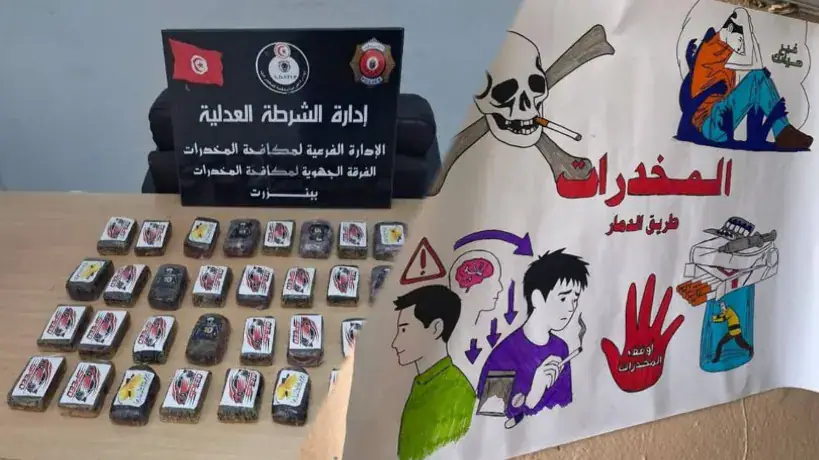
The authorities have been actively working to curb the supply of narcotics. On February 4, 2025, the Banzart judicial police seized nearly 180 grams of cocaine in the Ghazala delegation. On May 3, 2026, the Banzart regional anti-drug brigade confiscated six cannabis slabs in the Sijnan delegation. Large quantities of narcotics have been seized on Banzart's beaches, including in 2014, 2018, and 2020. In one of the biggest crackdowns, on October 2, 2025, police seized nearly 41,000 narcotic pills, 2,750 crystal syringes, and 9,945 different medication pills.
Despite these efforts, the repeated seizures suggest that drug networks can still meet demand across various delegations. On November 28, 2020, a girl died from an ecstasy overdose during a party in an eastern delegation. The phenomenon has attracted a worrying proportion of teenagers and young adults, some of whom have become involved in lucrative trade. On September 28, 2026, police in Banzart arrested a 16-year-old boy for promoting narcotics near an educational institution.
The Banzart governorate has a population of approximately 607,000 people, with 40% being children and young adults. The authorities have targeted this demographic with awareness and education campaigns. On July 9, 2025, a workshop on the dangers of addiction was organized in the Wadi Roumin youth center. On June 13, 2026, the Banzart youth radio and television club organized a regional meeting for young ambassadors against addiction.
The campaigns have continued, with the Regional Education Delegation extending the "Hour of Prevention" to a full day of awareness-raising on October 10, 2026. The event, which targeted 4,843 students, aimed to educate them about the risks of narcotics. On October 26, 2026, a workshop was organized on preventing narcotics in schools and educational institutions, bringing together school administrators, teachers, and youth workers.
The therapeutic approach to addressing addiction involves understanding, diagnosing, and treating psychological, behavioral, or physical problems. In 2015, the Banzart listening and addiction prevention cell encouraged 180 young people to share their experiences with addiction. On October 27, 2026, the Banzart Health Department announced the opening of "Hope" clinics to diagnose and treat addiction in several health centers.
However, the absence of a rehabilitation center in Banzart renders the exceptional legal procedure ineffective. The law provides for a penalty of one to five years in prison and a fine for consumption, but it does not initiate public prosecution against those who seek treatment for the first time. Meanwhile, the International Organization for Migration has reopened the Al-Amal addiction treatment center in Zghoun, but the lack of infrastructure in Banzart leaves a gap in services.
Key points
- Tunisian authorities are working to combat drug addiction by balancing supply and demand through awareness campaigns, seizures, and treatment programs.
- The absence of a rehabilitation center in Banzart hinders efforts to address addiction.
- A national study is set to be launched to provide accurate data on addiction in Tunisia.