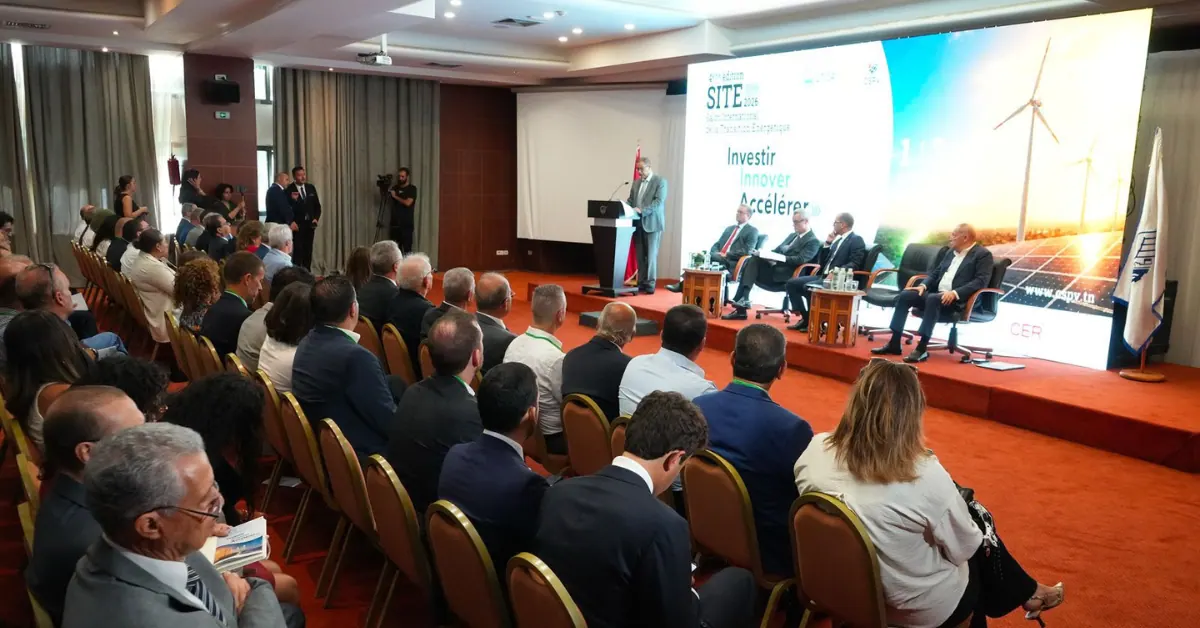
The fourth edition of the International Salon for Energy Transition (SITE 2026) concluded in Tunis, Tunisia, with a set of recommendations aimed at accelerating the country's energy transition and achieving national goals by 2030. The two-day conference, held under the supervision of the Ministry of Industry, Mines, and Energy, brought together around 60 specialized companies from Tunisia and abroad, as well as representatives from the public and private sectors, financial institutions, investors, and experts.
The conference participants called for the acceleration of programmed projects, the establishment of a permanent mechanism to address obstacles, and the review of the legislative framework for renewable energy production, particularly the 2015 law. They also proposed raising the ceiling for self-production of electricity, developing mechanisms for selling surpluses to the Tunisian Electricity and Gas Company, and stimulating private sector investments.
In terms of the investment climate, the participants recommended digitizing and simplifying procedures, reducing the number of required licenses and approvals, and establishing a "one-stop shop for energy" that brings together various concerned administrations. This, they argued, would help shorten the study period for files and facilitate the completion of investments.
The conference also recommended launching a "Energy Citizenship" program to enable one million Tunisian families to benefit from solar energy by providing accessible financing mechanisms for low- and middle-income households. Additionally, the participants called for the review of customs duties and value-added tax on solar panels, batteries, and equipment to reduce their cost for citizens and institutions.
The success of the energy transition, the participants emphasized, is linked to the modernization and digitization of the national electricity grid, as well as the development of control systems and smart meters. They recommended strengthening the high-voltage transport network, completing the connection between the north and south, and supporting electrical interconnection lines with Algeria and Libya.
In the field of green hydrogen, the participants called for a comprehensive framework that ensures energy, water, and agricultural security. They also recommended developing green financing mechanisms, reforming the Energy Transition Fund, and promoting partnerships between the public and private sectors to attract foreign investment.
The participants stressed that the main challenge lies in converting these recommendations into concrete projects and investments, and called for the establishment of a permanent consultation and follow-up mechanism that brings together public authorities, financial institutions, and the private sector.
Key points
- Recommendations include accelerating energy transition projects, enabling one million families to benefit from solar energy, and modernizing the national electricity grid.