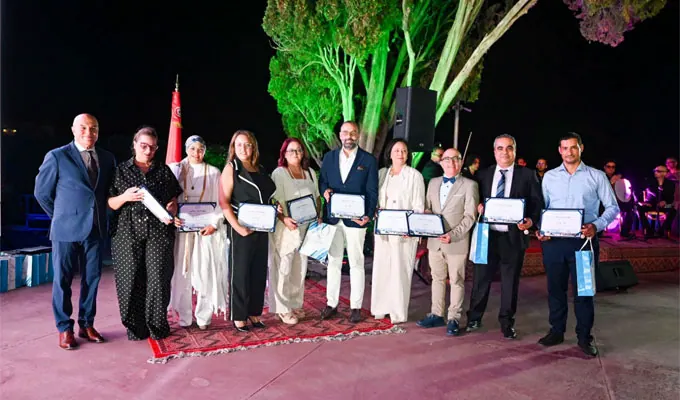
The Centre des musiques arabes et méditerranéennes in Sidi Bou Saïd hosted a celebration on September 27, 2026, to mark the occasion of receiving the official certificate of UNESCO World Heritage List inscription. The certificate was handed over to Tunisia's Ambassador and Permanent Delegate to UNESCO, Dhia Khaled, by Lazare Eloundou Assomo, Director of the World Heritage Centre. The event was attended by Tunisia's Minister of Cultural Affairs, the Director-General of the National Institute of Heritage (INP), Tarek Baccouche, and several ambassadors.
The inscription of Sidi Bou Saïd on the UNESCO World Heritage List is a culmination of a national effort led by the INP and various institutions. This is Tunisia's second achievement in 2026, following the inclusion of the Dahar Geopark in the UNESCO Global Geoparks Network in April. Minister of Cultural Affairs, Hayet Srarfi, emphasized that the selection of Sidi Bou Saïd for this celebration is due to its cultural and historical significance, with the Centre des musiques arabes et méditerranéennes being a prominent landmark in the village.
Srarfi highlighted that the inscription represents a milestone in Tunisia's national integrated approach to preserving cultural heritage. The ministry is currently preparing dossiers for other elements of Tunisia's heritage to be inscribed on the UNESCO World Heritage List, including the Oud, articles made from palm and vegetable fibers, and the Roman hydraulic complex of Zaghouan-Carthage.
Tarek Baccouche noted that Sidi Bou Saïd's unique urban planning, architecture, and spiritual significance made it possible for the village to be inscribed on the UNESCO World Heritage List. The village's distinctive character, which blends buildings, streets, and homes with its geographical setting, has earned it a place on the list.
With the inscription of Sidi Bou Saïd, Tunisia now has ten sites on the UNESCO World Heritage List, comprising nine cultural and one natural site. This brings the total number of Tunisian elements inscribed on UNESCO lists, including archaeological sites and intangible heritage, to 24.
The celebration also saw the minister presenting certificates to the scientific and technical team that contributed to the preparation of Sidi Bou Saïd's dossier, titled "The Village of Sidi Bou Saïd: A Centre of Cultural and Spiritual Inspiration in the Mediterranean."
Key points
- Sidi Bou Saïd's inscription on the UNESCO World Heritage List recognizes its cultural and historical significance.
- Tunisia has made significant progress in preserving its cultural heritage, with two major achievements in 2026.
- The country is preparing dossiers for other heritage elements to be inscribed on the UNESCO World Heritage List.