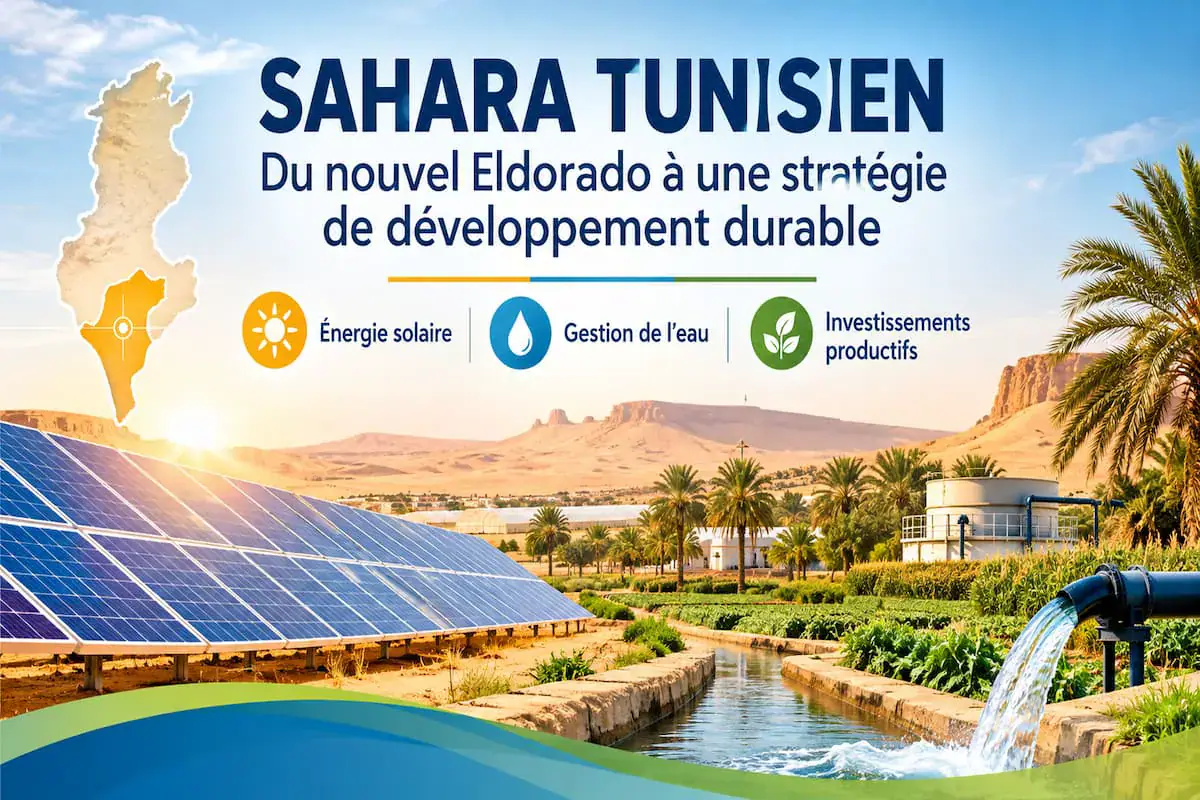
Tunisia's Sahara region has long been considered a new Eldorado, rich in natural resources and opportunities for development. However, the region's potential remains largely untapped, and the challenge lies in transforming its resources into productive activities, jobs, and wealth for the local population. A recent article by Sami Jallouli, published in L'Économiste maghrébin, highlights the need for a strategic approach to develop the region sustainably. The article raises important questions about how to harness the region's potential and create a model for sustainable development.
The Sahara region boasts several natural advantages, including significant solar potential, oases with traditional know-how, possibilities for agricultural diversification, tourism prospects, and opportunities for logistics, technical services, and local transformation. However, these advantages alone do not constitute a development model. The key is to determine which activities can thrive sustainably in the region, with what resources, under what economic model, and with what public responsibility. The 2026-2030 Development Plan, recently adopted, provides a framework for achieving results in the region.
The combination of solar energy and water is crucial for developing the Sahara region. Solar energy can reduce the energy costs of certain activities, power productive installations, and support water treatment systems. However, it is essential to distinguish between energy and water resources, as solar energy does not create water resources. The use of photovoltaic electricity can reduce pumping costs, but it is crucial to avoid uncontrolled withdrawals from groundwater sources to prevent long-term ecological and economic costs.
To ensure sustainable development in the Sahara region, it is essential to adopt a comprehensive approach that takes into account the availability of water resources, energy costs, and the economic value created. Each project should be evaluated based on three criteria: sustainable water availability, energy costs, and economic value creation. The reuse of treated wastewater and the potential mobilization of brackish water should also be explored, subject to precise sanitary and environmental requirements.
International experiences offer valuable lessons for Tunisia's Sahara region development. In Morocco, initiatives supported by the World Bank in the El Haouz irrigated perimeter combine modernization of irrigation and monitoring of groundwater withdrawals. In Egypt, the FAO has launched an irrigation initiative powered by solar energy, aiming to reduce dependence on fossil fuels and improve water use. China's experience with "agrivoltaics," which combines photovoltaic production and agricultural uses on the same site, also offers interesting insights.
The development of the Sahara region requires a coherent approach that aligns energy policy, water security, investment, and regional development. The goal should not be limited to multiplying infrastructure but should focus on producing measurable economic results. The 2026-2030 Development Plan provides a framework for achieving these results, and it is essential to ensure that the plan is implemented effectively.
In conclusion, Tunisia's Sahara region holds great potential for development, but it requires a strategic approach to transform its resources into productive activities, jobs, and wealth for the local population. By adopting a comprehensive approach that takes into account the availability of water resources, energy costs, and economic value creation, Tunisia can create a model for sustainable development in the region.
Key points
- The development of the Sahara region requires a coherent approach that aligns energy policy, water security, investment, and regional development.
- International experiences offer valuable lessons for Tunisia's Sahara region development, including the importance of monitoring groundwater withdrawals and promoting sustainable water use.
- The combination of solar energy and water is crucial for developing the Sahara region, and each project should be evaluated based on three criteria: sustainable water availability, energy costs, and economic value creation.