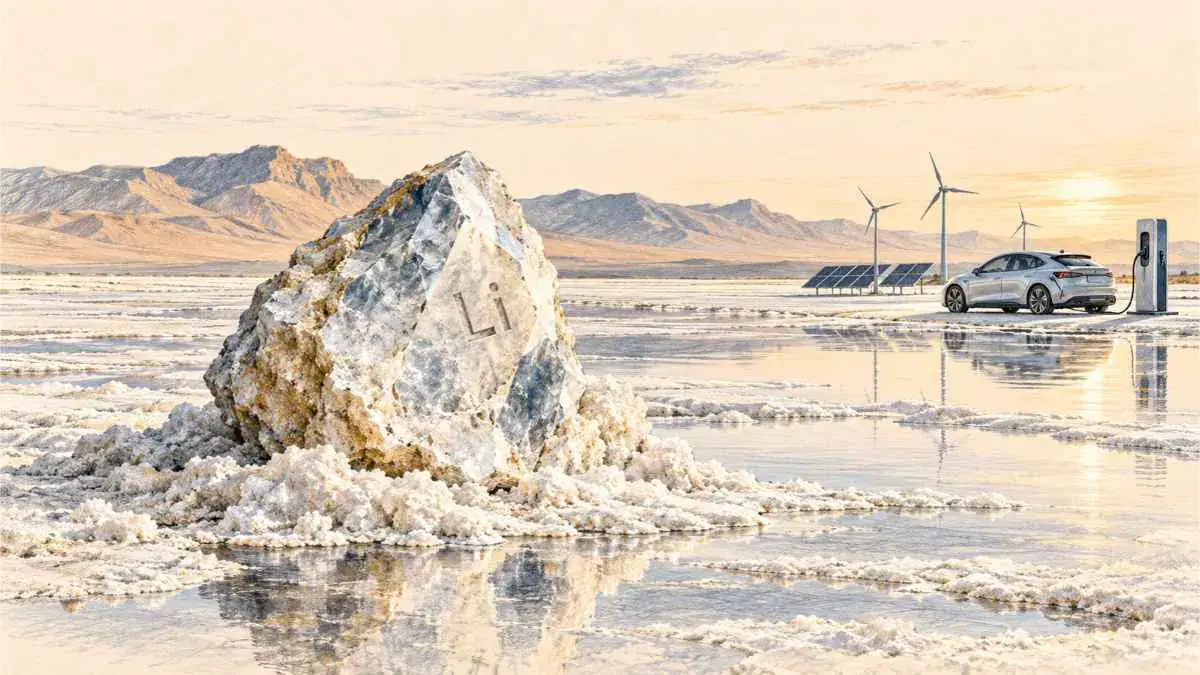
A recent scientific study published in the Lithium enrichment in a hypersaline brine: A genetic model and resource assessment for Chott El Jerid, Tunisia, reveals that Tunisia may hold a significant lithium reserve. Researchers Hassan Khlissa, Elhoucine Essefi, and Bart Van der Bruggen estimate that 142,500 tonnes of lithium are present in the brines of Chott El-Jérid, a vast salt flat in southern Tunisia. This discovery has the potential to transform Tunisia's economic prospects and position the country as a key player in the global energy transition.
Lithium has become a highly sought-after resource due to its crucial role in the production of electric vehicle batteries, energy storage systems, and electronic equipment. The global competition for access to critical minerals is intensifying, and Tunisia's potential lithium reserve could provide a significant advantage. However, the study emphasizes that this is an estimate of potential resources, not economically exploitable reserves. Further research is needed to determine the technical, economic, and environmental feasibility of extracting lithium from Chott El-Jérid.
The discovery of lithium in Tunisia could have far-reaching implications for the country's economy and global influence. Beyond its mineral wealth, Tunisia's lithium reserve could enable the country to develop a local value chain around energy technologies, including lithium refining, battery component manufacturing, and energy storage research. This could lead to the creation of specialized industrial hubs and attract international investors focused on the energy transition.
The presence of lithium in Tunisia could also enhance the country's geopolitical influence, particularly in its relations with European partners. The European Union is seeking to reduce its dependence on Asian suppliers and secure its critical mineral supplies. A confirmed lithium reserve in Tunisia could strengthen the country's position in its dialogue with European and Mediterranean partners, paving the way for new industrial, scientific, and technological partnerships.
However, any potential lithium extraction must be balanced with environmental concerns. Chott El-Jérid is a fragile ecosystem in a region already experiencing significant water stress. Any exploitation of lithium reserves must demonstrate not only economic viability but also environmental sustainability and compatibility with local ecological balances. Researchers emphasize that the feasibility of extraction remains to be demonstrated and is currently the subject of further study.
The Tunisian government and international partners must carefully consider the potential risks and benefits associated with lithium extraction. If managed responsibly, Tunisia's lithium reserve could provide a significant boost to the country's economy, attract new investment, and support the global energy transition. However, the country must navigate the challenges of environmental sustainability, technological development, and international cooperation to fully capitalize on this opportunity.
As the world reorients its supply chains around critical minerals, Tunisia's lithium reserve presents a unique chance for the country to strengthen its economic sovereignty, attract new investment, and consolidate its position in regional geopolitics. The coming months and years will be crucial in determining whether Tunisia can successfully harness its lithium reserve to drive sustainable development, innovation, and influence.
Key points
- - A recent study estimates that Tunisia's Chott El-Jérid region holds 142,500 tonnes of lithium in its brines. - The discovery could transform Tunisia's economy and position the country as a key player in the global energy transition. - Environmental sustainability and responsible management of lithium extraction will be crucial to maximizing the benefits of this discovery.