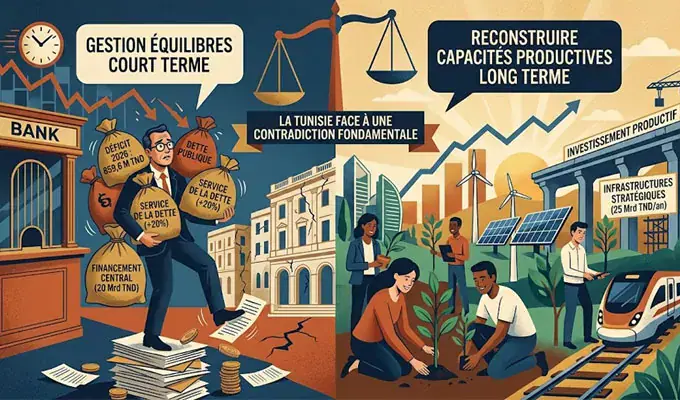
Tunisia's public finances are under strain, with a significant increase in the state's deficit and debt. According to data available up to June 2026, the state's deficit has reached 859.6 million dinars, a stark contrast to the 1.9 billion dinar surplus recorded during the same period in 2025. This deterioration is attributed to a 3.2% decline in total revenues and an 8.9% increase in expenditures. The rising debt servicing costs, up nearly 20%, further exacerbate the situation.
The financing of the budget has become a pressing concern, with the central bank's facilities to the treasury reaching nearly 20 billion dinars by the end of September 2026, a substantial increase from 1.4 billion dinars at the end of 2023. Economists warn that this strategy poses several risks, including pressure on foreign exchange reserves, high interest rates for businesses and households, and decreased financial attractiveness. The central bank's potential authorization to grant up to 9.8 billion dinars in additional facilities, as proposed in the 2027 finance bill, is seen as a financing mechanism rather than an additional deficit.
Investment has been noticeably absent from budgetary priorities, with investment expenditures accounting for only 21.2% of the amounts planned in the finance law during the first half of 2026. This has significant implications, as the country needs infrastructure development in areas such as water networks, energy, transportation, and renewable energy projects. Economists argue that prioritizing investment is crucial for enhancing productivity and competitiveness.
The energy deficit has become a systemic risk, with Tunisia now covering less than a third of its energy needs. The country's dependence on imported energy has increased to 67.6%, up from 7.5% in 2010. The rising cost of importing energy products, combined with the surge in international prices, is putting pressure on the country's external and public finances. The government has maintained a freeze on fuel prices since late 2022, which, while preserving purchasing power in the short term, has shifted the burden to the state.
The trade deficit continues to widen, reaching 21 billion dinars by the end of September 2026, a 25% increase over the previous year. Import growth outpaces export growth, and the geographic structure of trade remains heavily imbalanced. The European Union remains the primary market for Tunisian products, while imports from China, BRICS countries, and neighboring countries drive the trade deficit.
Economists Hachemi Alaya and Abdelbasset Sammari agree that Tunisia's budgetary problems stem primarily from a production deficit. They advocate for increased transparency, reforms to subsidies, and better protection for public investment. Sammari calls for a comprehensive exercise in budgetary transparency before the vote on the 2027 finance bill, while Alaya proposes gradual reforms.
The Tunisian government faces significant challenges in balancing short-term financial management with long-term growth objectives. The country's ability to address these challenges will depend on its capacity to prioritize investment, enhance production, and improve competitiveness. The upcoming 2027 finance bill will be crucial in determining the country's economic trajectory.
Key points
- Rising debt and deficits threaten Tunisia's long-term growth prospects.
- Investment has been neglected in budgetary priorities, with significant implications for the country's infrastructure development.
- The energy deficit has become a systemic risk, with Tunisia's dependence on imported energy increasing substantially.