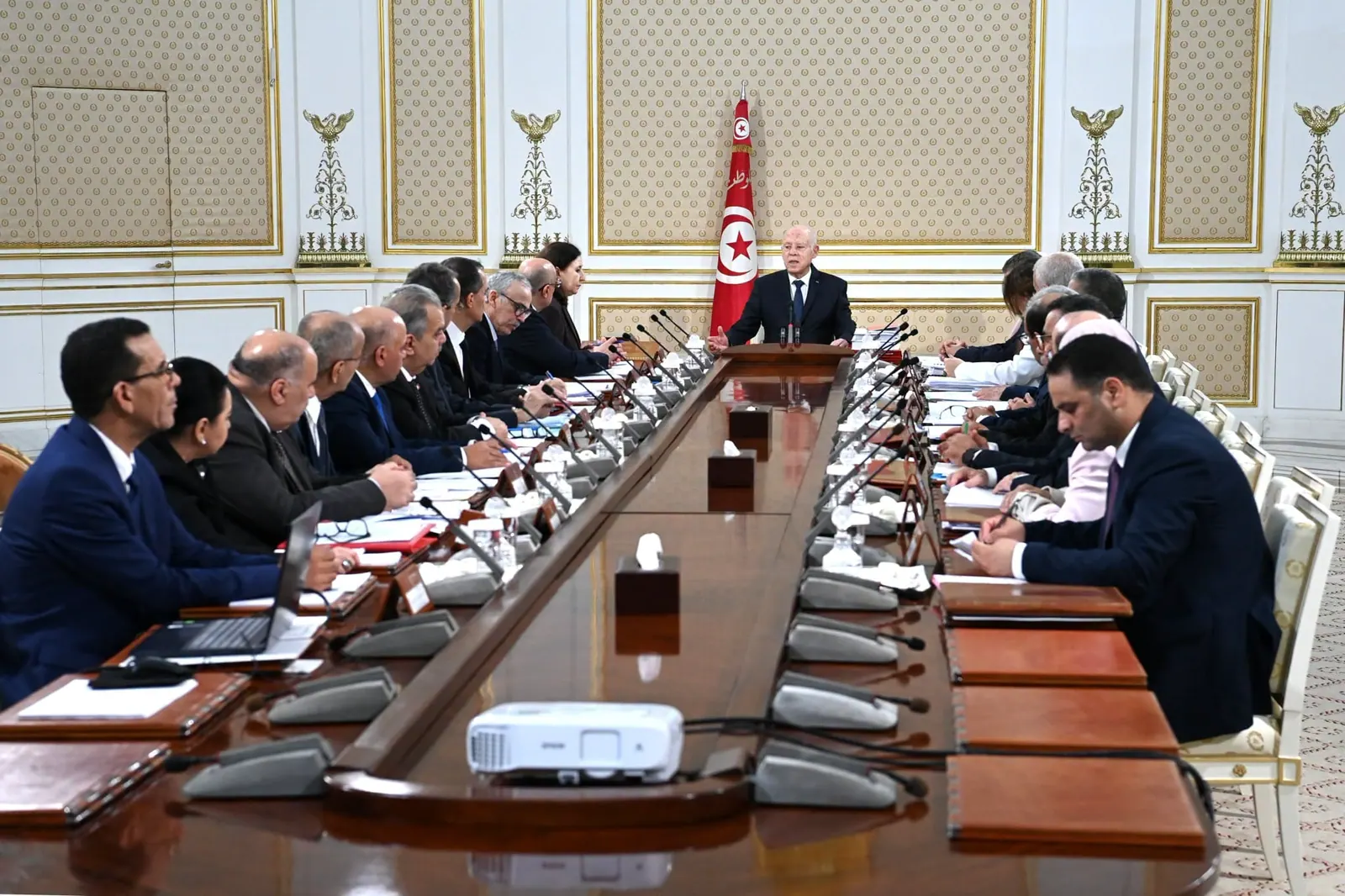
On September 29, 2026, President Kaïs Saïed presided over a Council of Ministers meeting at the Carthage Palace. The meeting focused on examining several decree projects and discussing public service operations. The Council reviewed a project to modify decree-law No. 54 of 2022, which relates to combating information and communication system offenses. This decree-law was initially issued on September 13, 2022.
The Council of Ministers also studied a project to amend decree-law No. 13 of 2022, issued on March 20, 2022. This decree-law concerns penal conciliation, allocation of its proceeds, and complements some of its provisions. Furthermore, the Council examined a project to modify certain provisions of the organic law No. 23 of 2012, dated December 20, 2012. This law relates to the Independent Higher Instance for Elections (ISIE).
Another project discussed during the meeting involves modifying certain provisions related to municipal councils. The President stated that he is closely monitoring the situation in different regions of the country. He emphasized that the Tunisian people are engaged in a liberation war on all fronts and will only accept a decisive victory. The President criticized what he termed as maneuvers by "pockets of reaction" and "stooges of colonialism."
The Council's meeting is part of the ongoing efforts to review and update the country's regulatory framework. The modifications to decree-law No. 54 of 2022 aim to enhance the fight against cybercrime and offenses related to information and communication systems. By making these changes, the government seeks to improve the effectiveness of its strategies in this area.
President Kaïs Saïed's statements reflect his commitment to achieving significant progress in Tunisia. He has consistently emphasized the importance of defending national interests and promoting a culture of resistance against foreign interference. The President's vision for the country's future is centered around the principles of sovereignty and independence.
The projects discussed during the Council of Ministers meeting demonstrate the government's focus on institutional and legislative reforms. These efforts are aimed at strengthening the country's democratic institutions and enhancing the efficiency of its public services. The modifications to the decree-laws and laws will be crucial in shaping Tunisia's future development.
The meeting's outcomes and the implementation of the discussed projects will be closely watched by various stakeholders, including civil society organizations and the general public. The government's ability to effectively address the country's challenges and promote stability will depend on the success of these initiatives.
Key points
- The Council of Ministers discussed several decree projects, including modifications to decree-law No. 54 of 2022 and decree-law No. 13 of 2022.
- President Kaïs Saïed emphasized the Tunisian people's determination to achieve a decisive victory in their liberation war.
- The projects aim to enhance the fight against cybercrime, improve penal conciliation, and strengthen democratic institutions.