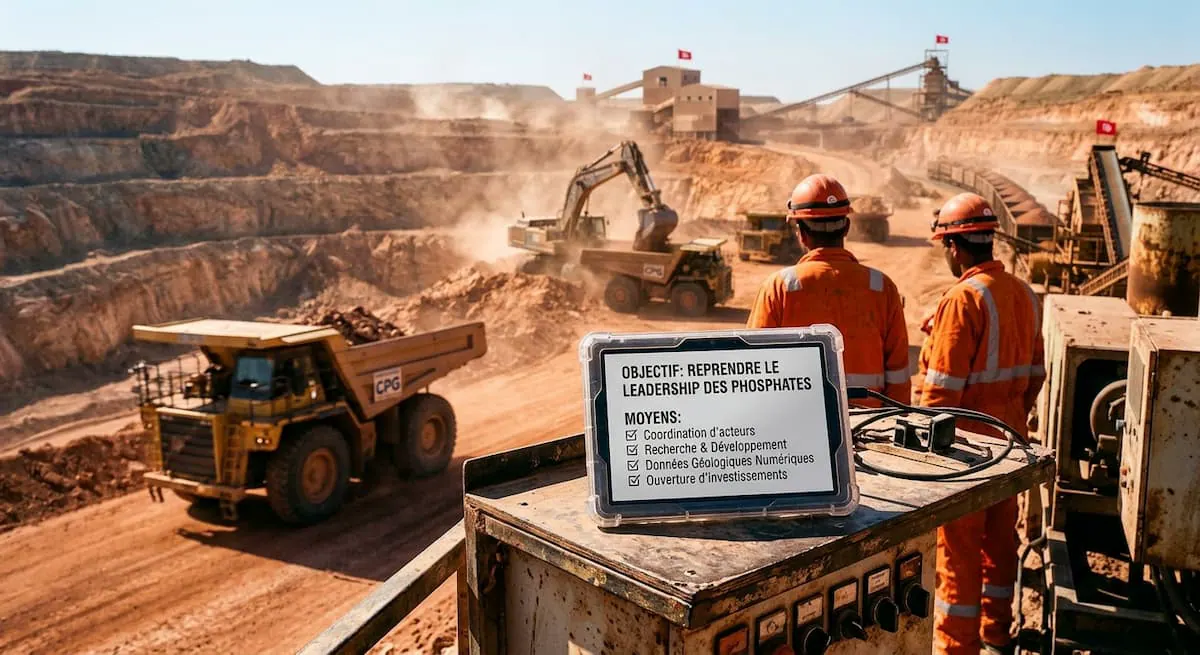
Tunisia's Minister of Equipment and Housing, Salah Zouari, has stated that the country is working to regain its position as a global leader in phosphates and derivatives. This statement was made at the Egyptian Mining Forum, where Zouari emphasized the importance of coordination between stakeholders, development of research and mining, and opening up to private investors. However, the current numbers tell a different story.
According to recent statistics, phosphate production in Tunisia has declined by 5.5% in the first half of 2026, with a total production of 1.73 million tons, compared to 1.84 million tons in the same period last year. Furthermore, exports of phosphates and derivatives have decreased by 19% during the same period. This decline is significant, especially when compared to the country's performance in 2010, when phosphate production reached 8.131 million tons.
The decline in phosphate production and exports is a concerning trend for Tunisia, especially when compared to other countries in the region. Morocco, for example, produced 36 million tons of phosphates in 2025, making it the second-largest producer globally, behind China. The Moroccan phosphate company, OCP, reported a revenue of 113.9 billion dirhams in 2025, with a significant increase in revenue from phosphate rock.
In an effort to revive the industry, the Tunisian phosphate company, CPG, has presented a plan to increase production to 9.4 million tons of phosphate by 2035, with a projected cost of 2,700 million dinars. The plan includes increasing production to 4.5 million tons in 2026 and 5 million tons in 2028. However, the company faces significant challenges, including transportation issues, water shortages, and social unrest.
The CPG and the Tunisian Chemical Group (GCT) have identified several obstacles that need to be addressed in order to increase production. These include a lack of water for phosphate washing, transportation issues, and social unrest. Additionally, the GCT relies heavily on imported raw materials, such as sulfur and ammonia, which can be costly and unreliable.
Minister Zouari has called for greater integration between the public and private sectors, as well as increased expertise and knowledge sharing between African and Arab countries. He believes that this will help to reduce Tunisia's dependence on imported raw materials and increase the competitiveness of the phosphate industry.
Despite the challenges facing the industry, the Egyptian Mining Forum has attracted significant attention, with over 6,000 visitors and 500 guests from 50 countries. However, no concrete announcements were made during the forum, and it remains to be seen whether Tunisia will be able to achieve its ambitious plans for the phosphate industry.
Key points
- Phosphate production in Tunisia has declined by 5.5% in the first half of 2026.
- Exports of phosphates and derivatives have decreased by 19% during the same period.
- Tunisia aims to increase phosphate production to 9.4 million tons by 2035.