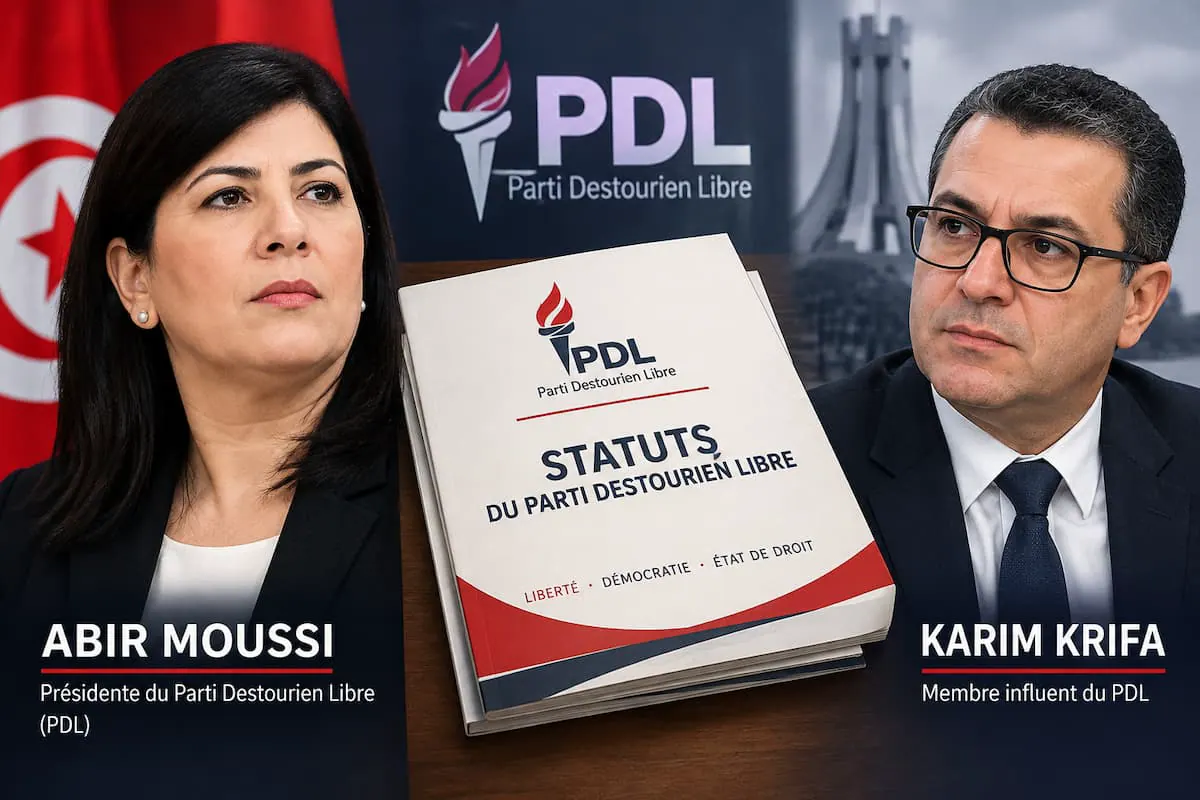
The Tunisian PDL party is going through a particularly agitated sequence, raising questions about its internal cohesion and political future. The party, once considered to have a solid political base, is now facing turbulence that is testing its unity and organization. A series of controversies has emerged, including the suspension of its national congress, disagreements over a new mandate for its president, Abir Moussi, and a public rupture between Moussi and lawyer Karim Krifa.
The PDL's national congress, scheduled for October 3-4, 2026, was suspended by a decision from the Tunis Court of First Instance's chamber of references on October 2. The suspension came as the party was preparing to renew its leadership and Moussi was seeking a new mandate. The judicial procedure, initiated in a context of internal disagreements over the congress's organization, interrupted an important political event for the party's future. This episode reveals that disagreements within the PDL have moved from internal discussions to the judicial arena.
The leadership question is a major point of friction within the party. In July, former MP and party member Majdi Boudhina publicly called on Abir Moussi to renounce seeking a new mandate, citing the need to renew leaders and respect the principle of alternation. This stance highlighted a debate over the interpretation of the PDL's statutes and the duration of mandates for its presidency. The party defends the legitimacy of Moussi's new candidacy, based on its interpretation of statutory provisions.
The debate over leadership renewal became more public with Majdi Boudhina's departure from the PDL. After defending the need for leadership renewal, Boudhina announced his withdrawal from the party, amid strong reactions from some of Moussi's supporters. His departure illustrates the tensions caused by the debate over the party's future and raises questions about the space given to internal dissent and the party's ability to manage differences without causing new ruptures.
A new dimension was added to the tensions within the PDL with the public rupture between Abir Moussi and Karim Krifa. On October 9, Moussi asked Krifa to withdraw from her defense committee and cease intervening in judicial cases and procedures initiated in her name. Krifa reacted three days later, indicating that he did not wish to engage in an exchange of accusations but reserved the right to initiate judicial procedures against those responsible for diffusing allegations against him.
This confrontation between two personalities long associated with the PDL adds a new dimension to the current tensions, concerning not only the party's organization and direction but also the relationships between its leaders and the modalities of defense of its president. The accusations formulated by the protagonists must be considered as their own declarations and not as judicially established facts.
The PDL's internal turmoil raises questions about its ability to preserve its cohesion in the face of contestation on several fronts. The party's future is uncertain, and it is unclear whether it will be able to overcome its internal divisions and maintain its unity. The situation remains fluid, with no clear resolution in sight.
Key points
- The PDL party's internal turmoil includes a suspended congress, leadership disputes, and a public rift between its president, Abir Moussi, and Karim Krifa.
- The party's leadership and organizational structures are being contested, raising questions about its future and ability to maintain unity.
- The situation remains fluid, with no clear resolution in sight for the PDL's internal divisions.