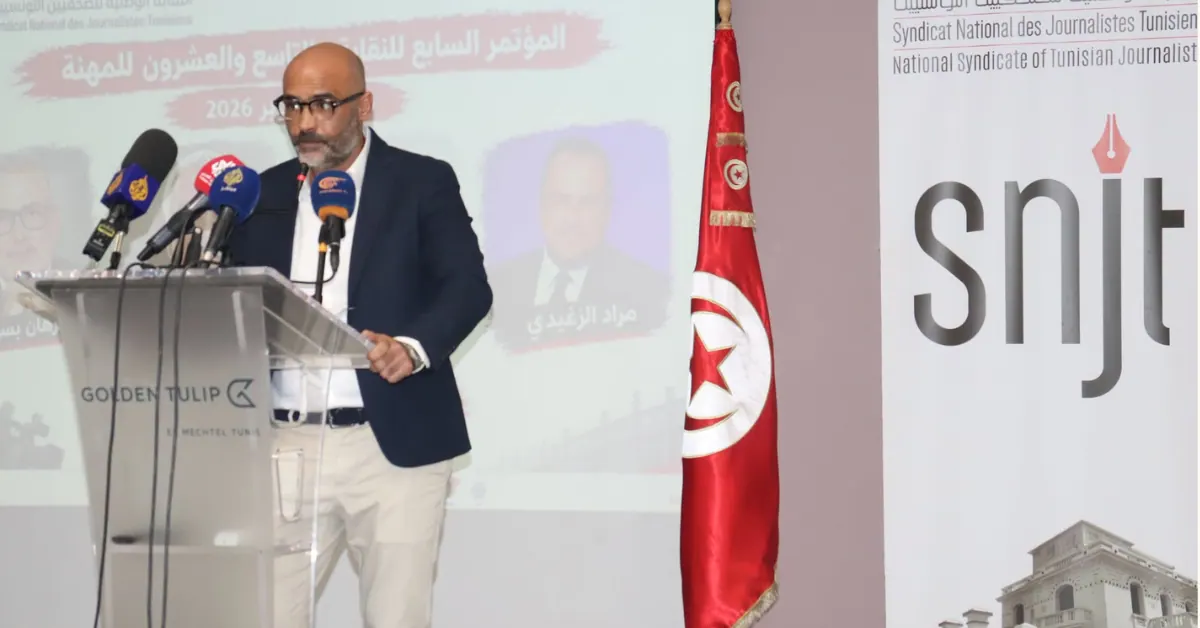
The National Journalists' Union of Tunisia (SNJT) is holding its seventh congress in Tunis, a significant event that brings together journalists and representatives from various national organizations. The congress, which started on Saturday and continues until Sunday, October 11, aims to address crucial issues affecting the journalism profession. One of the key events is the election of a new executive bureau, which will lead the union for the next three years. A total of 15 candidates have filed nominations for the executive bureau, although one candidate, Aymen Rfouri, has since withdrawn.
The congress takes place at a critical time for the journalism profession in Tunisia, with many journalists facing judicial proceedings and others being imprisoned. The SNJT's secretary-general, Ziad Dabbari, called for the immediate release of imprisoned journalists and an end to judicial proceedings against dozens of journalists. He emphasized that press freedom is not a privilege for a specific group but a right for society to access information. Dabbari also stressed the importance of the union's independence, which he believes is linked to the independence of journalists themselves and their ability to exercise their professional rights.
The issue of press freedom and guarantees for practicing journalism was a dominant theme in the opening speeches of the congress. Bouabaker Belthab, the Dean of Lawyers, called for the release of all those arrested in cases related to freedom of expression and opinion. He emphasized that a free and independent press is a cornerstone of a democratic society based on respect for the constitution and laws. Belthab also announced a national march scheduled for October 17 to defend basic rights and freedoms.
The SNJT was established in 2008, marking a significant transformation in the professional representation of journalists in Tunisia. Since its inception, the union has experienced various organizational and electoral milestones, influenced by the country's transformations before and after the revolution. The congress is an opportunity to evaluate the union's performance and discuss its future role in defending journalists' rights and freedoms.
The seventh congress is taking place in a different context, with traditional demands for journalists' rights, such as salaries, job security, and social coverage, overlapping with broader issues related to digital transformations, changes in news consumption patterns, and the economic difficulties faced by many media institutions. The election of a new executive bureau will have a significant impact on the union's future and its ability to address these challenges.
Salah Eddine Salmi, the General Secretary of the Tunisian General Labor Union (UGTT), expressed his support for the journalists and emphasized the importance of unity among civil and social organizations to defend common rights and freedoms. He announced a national social and peaceful march scheduled for October 17, which will bring together various organizations, unions, and associations.
The SNJT's seventh congress raises essential questions about the union's role in defending journalists' rights, promoting press freedom, and ensuring the independence of the profession. The new executive bureau will face significant challenges in addressing these issues and navigating the complex landscape of Tunisian politics and society. The outcome of the congress will have a lasting impact on the future of journalism in Tunisia.
Key points
- The SNJT's seventh congress focuses on leadership, press freedom, and journalists' rights in Tunisia.
- The congress aims to address crucial issues affecting the journalism profession, including judicial proceedings against journalists and the importance of press freedom.
- The new executive bureau will play a significant role in shaping the union's future and its ability to address the challenges facing the journalism profession in Tunisia.