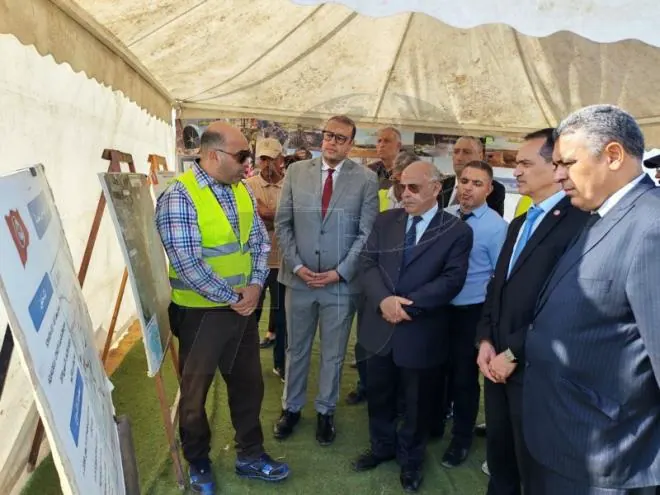
Tunisia's Minister of Agriculture, Ezzeddine Ben Cheikh, recently visited the construction site of the Saïda dam-reservoir project in Oued Ellil, Manouba governorate. He urged for the acceleration of the project's completion. The dam's construction is 92% complete, with an expected operational date to provide 45 million cubic meters of water for the Greater Tunis area, Cap Bon, and Sfax regions. The project aims to improve water supply for irrigation and drinking water.
The Saïda dam-reservoir project, initiated in February 2019, is part of a larger system to transfer excess water from the north to the Greater Tunis, Cap Bon, Sahel, and Sfax regions. The project includes five pumping stations with capacities ranging from 4.6 to 9.2 cubic meters per second. Ben Cheikh emphasized the need to complete the project's various components within six months. He also inspected the Kalaa Kebira dam-reservoir project, which is 98% complete and expected to be finished by the end of November.
The project is financed by the Arab Fund for Economic and Social Development (FADES) and the Tunisian state budget. It comprises 115 transfer canals connecting Saïda to the Belli reservoir in Nabeul governorate, along with balancing reservoirs. Two reservoirs are located in Manouba governorate, and one in Khanguet El Hojej, Nabeul governorate, each with a capacity of 20,000 cubic meters. The system relies on storing raw water in the Saïda dam-reservoir before transferring it to the Belli and Kalaa Kebira reservoirs.
According to Rafik Sbaa, director of the unit responsible for implementing the Saïda and Kalaa Kebira dam-reservoir projects, the water transfer system aims to supply the Sahel desalination plant. The project's progress was previously hindered by issues related to land acquisition and regularization of property situations. However, these challenges have been resolved through the allocation of 7 million dinars in compensation to affected residents.
Ben Cheikh's visit highlights the government's commitment to addressing the country's water supply needs. The completion of the Saïda and Kalaa Kebira dam-reservoir projects is expected to significantly enhance the region's water resources. The minister's push for accelerated completion underscores the project's importance in supporting the country's agricultural and drinking water requirements.
The project's pumping stations are designed to operate simultaneously, with an expected completion date of 2030. Once operational, the dams will play a crucial role in regulating the region's water supply. The Tunisian government's investment in the project demonstrates its efforts to improve the country's water infrastructure and mitigate potential shortages.
The successful completion of the Saïda dam-reservoir project will contribute to Tunisia's efforts to address its water supply challenges. The project's progress and expected outcomes will be closely monitored by the government and local communities. The enhanced water supply is expected to have a positive impact on the region's agriculture, industry, and drinking water needs.
Key points
- The Saïda dam-reservoir project is 92% complete and expected to provide 45 million cubic meters of water for the Greater Tunis area and other regions.