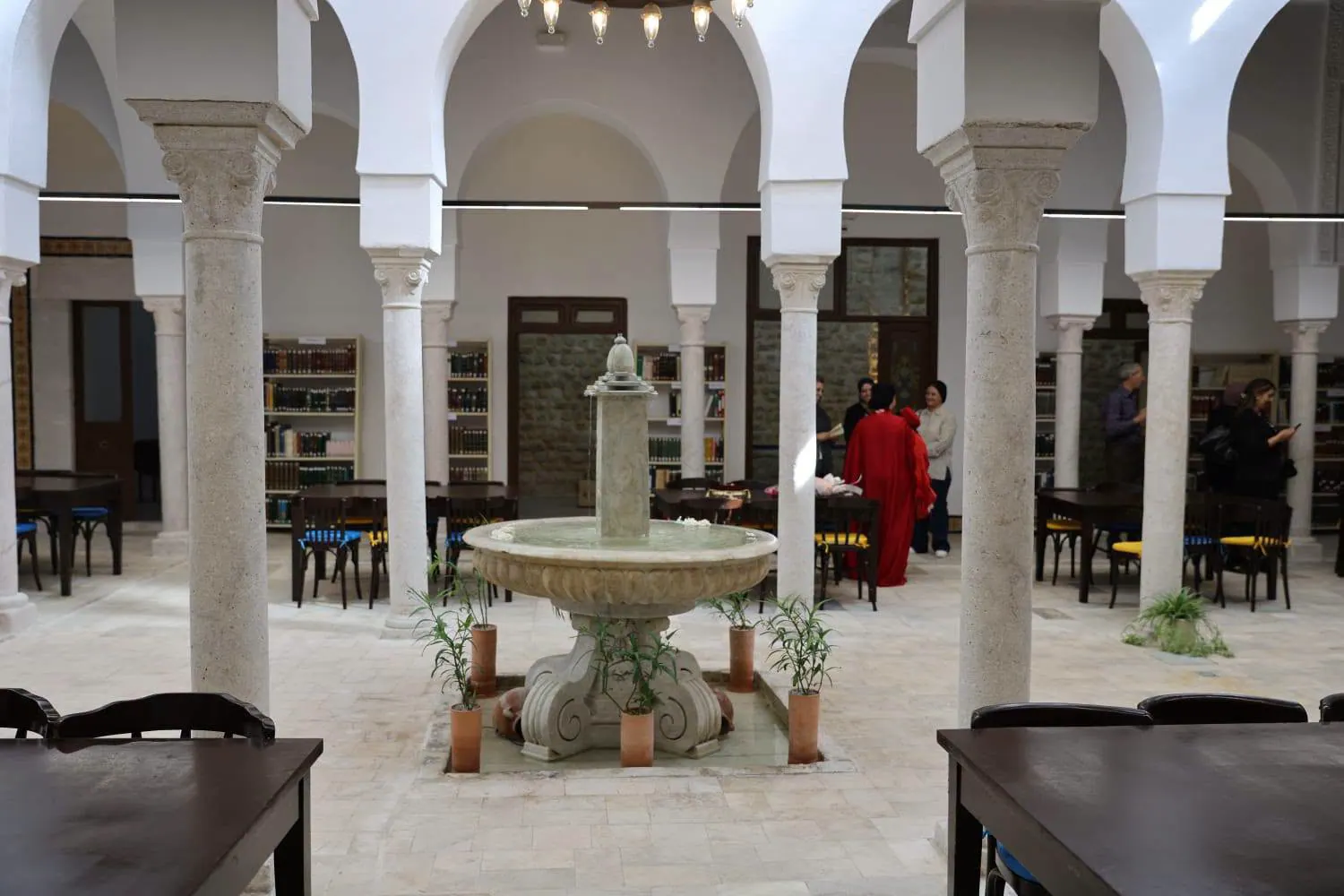
The Diwan library in Tunisia's old city has reopened after a comprehensive restoration project. The library was officially reopened on October 12, 2026, by Minister of Cultural Affairs Amira Srarfi, in the presence of Tunis Governor Imad Boukhris and several ministry officials. The historic landmark underwent significant maintenance and restoration work carried out by the National Heritage Institute.
The restoration project involved addressing humidity issues, restoring floors and tiles, and rehabilitating the library's fountain. The project also included updating the electrical network, removing random extensions, and integrating a new network supported by aesthetic lighting that highlights the library's architectural features. The walls were reinforced, and surfaces were isolated by injecting cracks with supporting limestone materials.
The restoration work aimed to preserve the library's original materials and traditional techniques, showcasing its historical identity and adhering to its architectural and engineering characteristics, in line with international standards for heritage preservation. The technical and specialized services ensured that the interventions respected the building's original features.
The comprehensive restoration project included renewing the roof insulation, adjusting water slopes to prevent rainwater accumulation, and maintaining the library's woodwork and wooden elements. The project demonstrates a commitment to protecting Tunisia's cultural heritage and ensuring its sustainability for future generations.
The Diwan library is a significant cultural and historical landmark in Tunisia, and its restoration is a welcome development for the country's cultural scene. The library is expected to continue serving as a center for learning and cultural activities, promoting Tunisia's rich history and heritage.
The reopening of the Diwan library coincides with several other significant events in Tunisia, including the World Health Summit in Berlin, where Tunisia defended its health sovereignty and called for equal partnerships. The country also agreed with Indonesia to enhance cooperation in pharmaceutical monitoring and food safety.
The restoration of the Diwan library is a testament to Tunisia's efforts to preserve its cultural heritage and promote its historical landmarks. The project's success demonstrates the country's commitment to protecting its rich history and ensuring the sustainability of its cultural institutions.
Key points
- The Diwan library reopened on October 12, 2026, after a comprehensive restoration project.
- The restoration work was carried out by the National Heritage Institute and aimed to preserve the library's original materials and traditional techniques.
- The project included updating the electrical network, restoring floors and tiles, and rehabilitating the library's fountain.