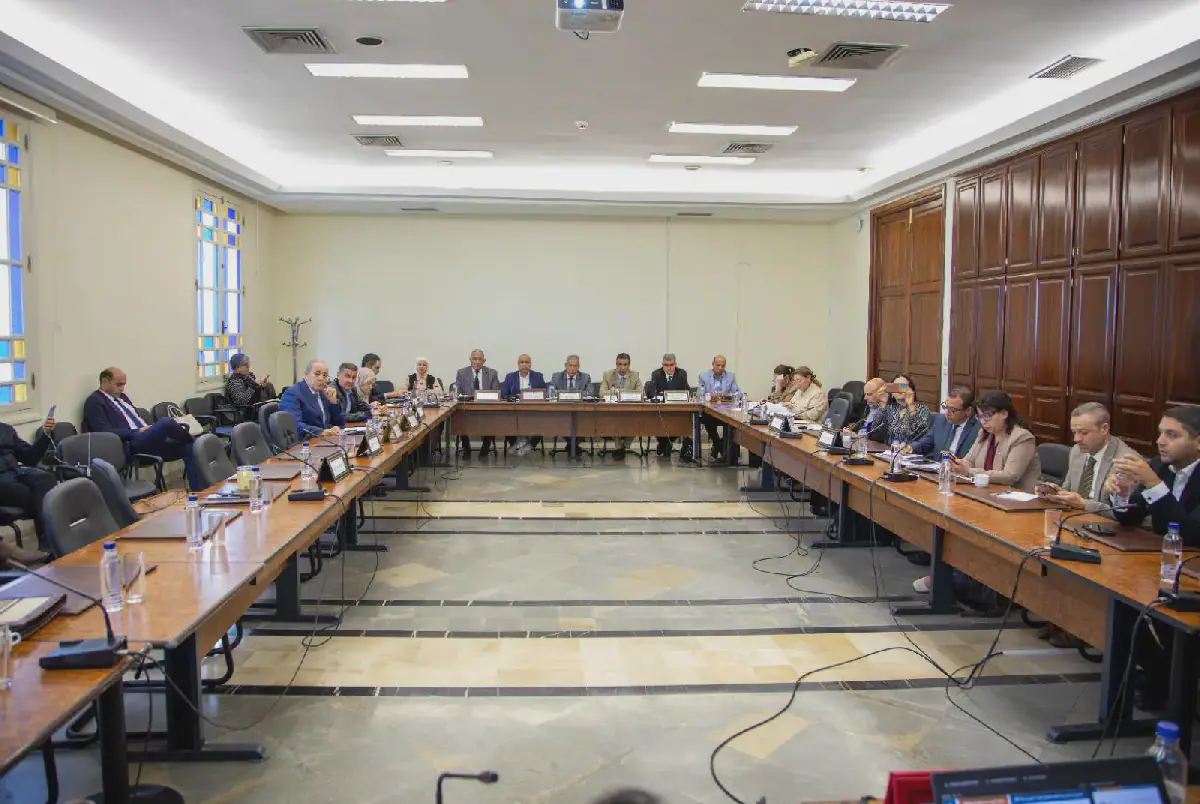
The Committee on Social Services and Development of Tunisia's National Council of Regions and Districts held a joint working session with the Committee on Education, Vocational Training, Scientific Research, Youth, and Sports of the People's Assembly of Tunisia. The session, chaired by Rafik Chennoufi, focused on the 2027 budget for the Ministry of Higher Education and Scientific Research. Minister Monther Belaid presented a detailed overview of the ministry's priorities and budget estimates.
The proposed budget for 2027 is 2.484,044 million dinars, representing a 4.41% increase from 2026. The minister highlighted that the sector oversees 278,789 students in public universities and 56,370 in private universities, with a student-to-teacher ratio of 11:1. In 2025, the country recorded 11,611 scientific publications, with nearly half published in top-tier journals. Tunisia ranks 71st out of 139 countries in the 2026 Scientific Innovation Index.
The ministry's priorities for 2027 include reviewing master's and doctoral programs, integrating artificial intelligence into teaching, and revising regulations for private higher education. The minister also emphasized the need to link research to the country's development needs, expand accommodation and food services, and continue digitizing ministry services. The committee members raised concerns about the employability of graduates, the quality of education in private universities, and the need for more investment in research.
The committee members also discussed the issue of 400 service providers employed by research institutions for over a decade, seeking to regularize their status. They called for a national strategy to address the challenges facing the higher education sector, including the need for more resources, better infrastructure, and improved services. The minister assured that the ministry is working to address these concerns, including a plan to build or expand 17 student dormitories and upgrade 71 private dormitories.
The minister emphasized that artificial intelligence is a double-edged sword and that the ministry is exploring ways to harness its potential while ensuring its safe and responsible use. He also highlighted the importance of partnerships between universities and the private sector to drive innovation and entrepreneurship. The committee members requested more information on the ministry's plans to support students with disabilities and to improve the overall quality of university services.
The minister reported that the ministry's self-generated resources mainly come from registration fees and that efforts are underway to update the regulatory framework for university autonomy. He also mentioned that around 450 out of 500 employees scheduled for recruitment in 2027 will be assigned to university services. The committee members welcomed the minister's commitment to addressing their concerns and to working towards improving the higher education sector.
The review of the 2027 budget for the Ministry of Higher Education and Scientific Research highlights the challenges and opportunities facing Tunisia's education sector. The committee's discussions emphasized the need for a more strategic approach to education and research, with a focus on employability, innovation, and social responsibility. The minister's presentation and responses to committee members' questions demonstrate the ministry's commitment to reform and improvement.
Key points
- The 2027 budget for Tunisia's Ministry of Higher Education and Scientific Research is 2.484,044 million dinars, representing a 4.41% increase from 2026.
- The ministry oversees 278,789 students in public universities and 56,370 in private universities, with a student-to-teacher ratio of 11:1.
- The ministry's priorities for 2027 include reviewing master's and doctoral programs, integrating artificial intelligence into teaching, and revising regulations for private higher education.
Reporting sources
- Radio Monastir · Radio Monastir