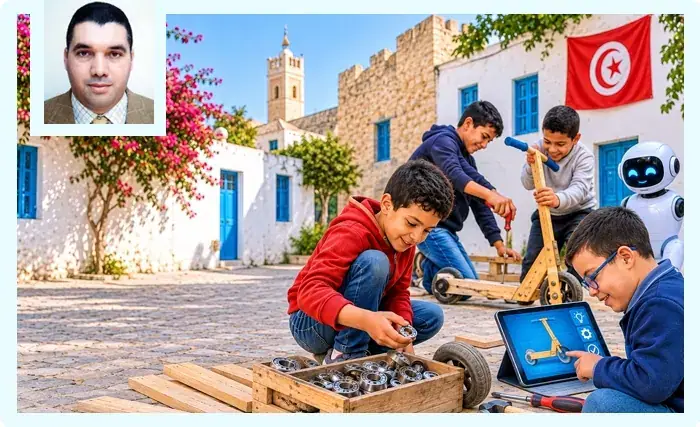
In the 1970s, Tunisia's environment was not a fixed entity, but a reservoir of variables to be transformed. Children in the Souk Sidi Abdessalem in Tunis would collect used ball bearings and wooden planks to build artisanal scooters, a concept that would later become popular in Europe. This DIY approach to problem-solving was not limited to toys, as children also created homemade movie projectors using cardboard boxes, paper rolls, and yogurt containers.
The Tunisian household was a closed-loop system optimized for sustainability. Clothing was repurposed into rugs, and electronic devices were repaired multiple times rather than discarded. Food waste was fed to family livestock, closing the biological loop. This approach to consumption and waste management was not only environmentally friendly but also fostered a culture of creativity and resourcefulness.
The education system in Tunisia during the 1970s was informal, yet effective in teaching children important skills. By working with everyday materials, children developed problem-solving abilities and a deep understanding of the physical world. This hands-on approach to learning allowed children to think creatively and develop innovative solutions to everyday problems.
However, with the adoption of Western-style consumerism, Tunisia's approach to innovation and sustainability began to change. The increasing reliance on technology and artificial intelligence has led to a decline in critical thinking and problem-solving skills. The use of generative AI has industrialized cognitive outsourcing, transforming intellectual laziness into an instant reflex.
The consequences of this shift are far-reaching, with three key areas of concern. Firstly, the disappearance of deductive effort has prevented the brain from developing its abstract thinking capabilities. Secondly, the illusion of mastery has led to a lack of understanding of underlying concepts. Finally, the extinction of critical doubt has resulted in a loss of critical thinking skills.
To reverse this trend, Tunisia needs to adopt a new strategy that prioritizes self-sufficiency and critical thinking. This can be achieved by rethinking the education system to focus on hands-on learning and problem-solving. The use of AI should be reevaluated to encourage critical thinking rather than dependency.
A national model of sustainability can be built around Tunisia's historical culture of frugality and circular economy. By transforming this culture into a national industry, Tunisia can become a leader in sustainable development. It is time for Tunisia to reconnect with its innovative past and forge a new path that balances modernization with self-sufficiency.
Key points
- Tunisia's past emphasis on self-sufficiency and creativity is being rediscovered by the Western world as a model for sustainable living.
- The country's adoption of Western-style consumerism has led to a decline in critical thinking and problem-solving skills.
- A new strategy prioritizing self-sufficiency, critical thinking, and hands-on learning can help Tunisia become a leader in sustainable development.