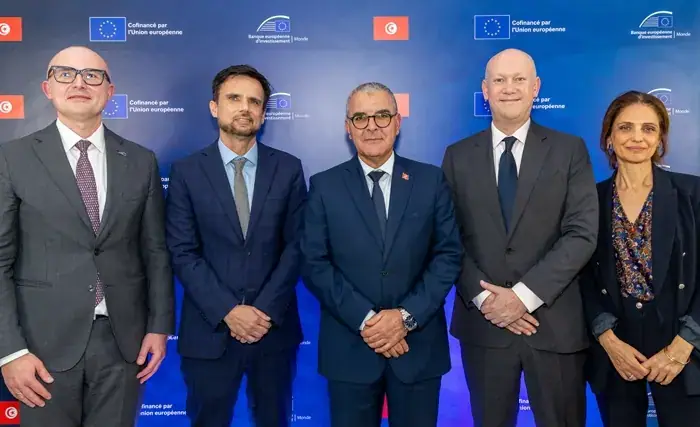
The Tunisia Economic Recovery Line, a 170 million euro initiative launched by the European Union (EU) and the European Investment Bank (EIB), has made significant progress. At a recent meeting in Tunis, stakeholders gathered to discuss the line's impact. The meeting included Tunisian authorities, the Central Bank of Tunisia, EU representatives, six partner financial institutions, and beneficiary businesses. The line has already disbursed 59.67 million euros to 457 Tunisian businesses.
A total of 581 financing requests were received, with 56.4% of the allocated funds already mobilized. Samir Abdelhafidh, Minister of Economy and Planning, praised the EIB's support for Tunisia's development process. He emphasized that the financing line aligns with the government's priorities, particularly supporting the private sector and small and medium-sized enterprises (SMEs). Abdelhafidh highlighted that SME support remains a crucial aspect of Tunisia's national development strategy.
The Tunisia Economic Recovery Line aims to improve access to medium- and long-term financing for Tunisian SMEs and intermediate-sized enterprises. The line is implemented by the Central Bank of Tunisia in cooperation with six partner financial institutions: Amen Bank, Bank ABC Tunisia, Banque de Tunisie, UBCI, ATL, and Tunisie Leasing & Factoring. The initiative has received backing from the EU under the Team Europe approach and the Trade & Competitiveness program.
The majority of approved financing, 89.45%, has gone to SMEs. The territorial coverage of the initiative is also significant, with beneficiary businesses in 23 of Tunisia's 24 governorates. Notably, 250 businesses, or 54.7% of beneficiaries, are located in regional development areas. The industry sector has received 33.3% of the financing, followed by energy with 12%, and health with 13.5%.
A significant proportion, 56.5%, of the financed volumes have benefited young people, women, or businesses in priority regions. These results are part of the broader efforts of Team Europe in Tunisia to support the private sector and SMEs, promoting investment, competitiveness, and job creation. The initiative aims to contribute to more inclusive growth in Tunisia.
The financing line remains open to businesses seeking to invest or expand their activities. It can finance a wide range of investment projects, leasing operations, and working capital needs. Eligible businesses can also benefit from an investment grant financed by the EU and implemented by Expertise France under Rawafed+. This grant can represent up to 10% of the financing obtained, capped at 50,000 euros.
EU and EIB representatives have welcomed the initiative's progress. Emanuel Amaral, Head of EU Cooperation in Tunisia, emphasized the importance of the partnership in facilitating access to financing for Tunisian businesses, particularly SMEs. Richard Amor, EIB Director of Enlargement and Neighborhood, highlighted the encouraging results and the need to accelerate the dynamic, mobilizing the available financing to support businesses, employment, and territories.
Key points
- The Tunisia Economic Recovery Line has approved 59.67 million euros in funding for 457 businesses.
- The initiative aims to support the private sector, particularly SMEs, and promote investment, competitiveness, and job creation.
- The financing line remains open to businesses seeking to invest or expand their activities.