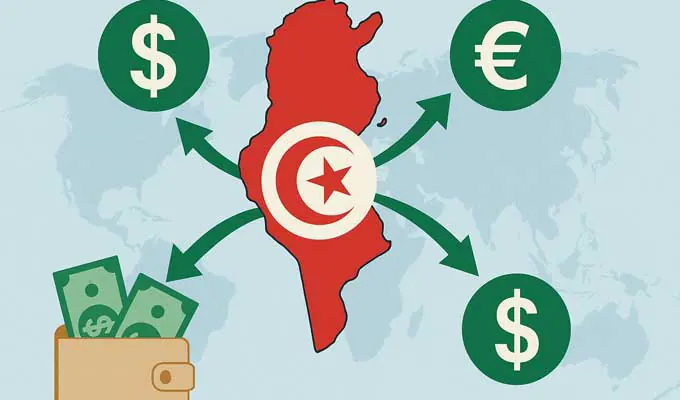
The recent announcement of Tunisia's inclusion in J.P. Morgan's Government Bond Index–Emerging Markets Edge (GBI-EM Edge) has generated significant attention in financial circles. Effective September 19, 2026, the country's sovereign debt in dinars will be part of this prominent index, which covers approximately $328 billion in local currency debt across 26 markets. This development is expected to increase the visibility of Tunisian bonds among international investors.
The 5.32% weighting assigned to Tunisia within the index measures the proportion of Tunisian securities in the benchmark. However, this does not imply that 5.32% of the $328 billion represented by the index will be invested in Tunisia. An index serves as a market reference, not a financial envelope for distribution. Therefore, the immediate impact is an increase in the international visibility of Tunisian bonds, but actual capital inflows remain uncertain.
The GBI-EM Edge index is designed to track local currency debt in emerging markets, providing investors with a benchmark for these assets. With Tunisia's inclusion, the country's debt will be evaluated alongside that of other emerging markets. This development may attract more investors to the Tunisian bond market, potentially leading to increased demand and improved liquidity.
Despite the increased visibility, the real test of this inclusion will be the actual flow of capital into Tunisia. If investors use the GBI-EM Edge as a reference and acquire Tunisian bonds, this could lead to higher bond prices and lower yields. However, this effect is contingent on the level of investment and the resulting impact on market liquidity.
A key indicator of the success of this inclusion will be the liquidity of the secondary market. Increased investor participation and trading activity could facilitate the exchange of securities. Conversely, if the inclusion does not lead to a significant increase in trading volumes, the impact may be limited to enhanced visibility.
The entry into the GBI-EM Edge index is a positive development for Tunisia, but its actual impact will depend on several factors. These include the level of capital invested, observed yields, and market liquidity. The country's ability to attract foreign investment will be crucial in determining the long-term effects of this inclusion.
Moving forward, investors and analysts will closely monitor Tunisia's performance within the GBI-EM Edge index. The country's weighting of 5.32% is significant, but it is subject to a cap of 8% per country. As the index evolves, Tunisia's position within it will be an important indicator of its economic prospects and investor confidence.
Key points
- The inclusion of Tunisian debt in the GBI-EM Edge index increases its international visibility, but actual capital inflows remain uncertain.
- The impact of this inclusion will depend on several factors, including capital invested, observed yields, and market liquidity.
- Tunisia's weighting in the index is 5.32%, subject to an 8% cap per country.