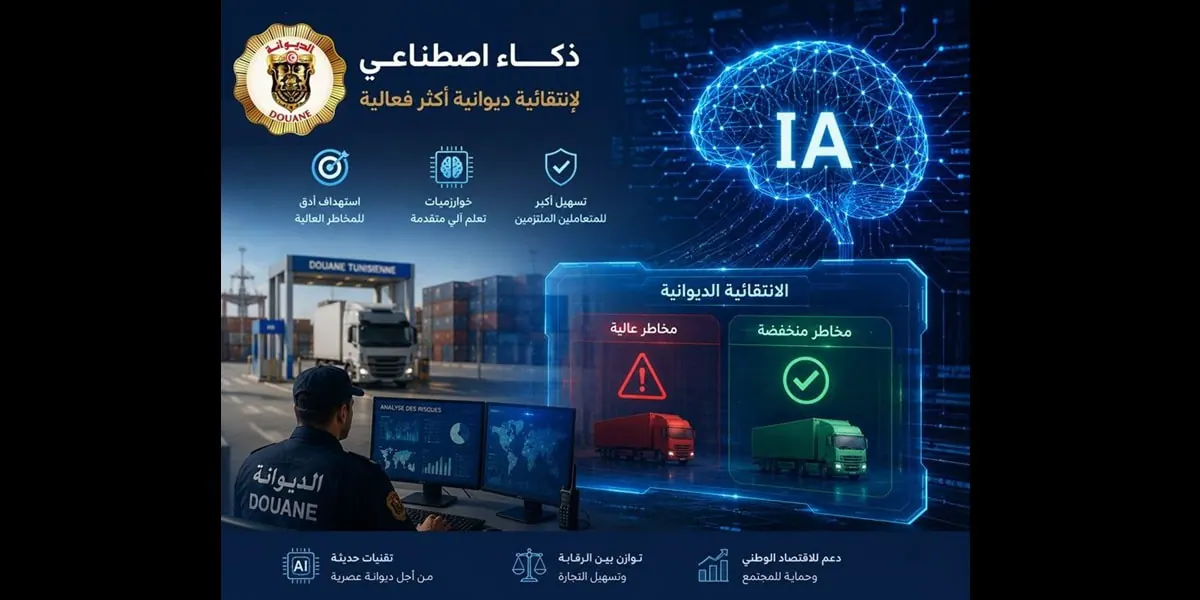
The Tunisian customs agency is set to integrate artificial intelligence into its risk management and customs declaration targeting system by the end of November 2026. This move aims to improve the detection of suspicious transactions and enhance the fight against smuggling. The announcement was made by Colonel Kais Ben Zayed, head of the authorized economic operator office at the General Directorate of Customs, on October 9.
The AI system will enable the customs agency to better select declarations with a high risk of infringement, while facilitating procedures for economic operators that comply with regulations. In 2025, the Tunisian customs agency analyzed over 1.5 million customs declarations. The implementation of AI and machine learning will help analyze these large volumes of data to identify cases requiring in-depth controls.
The goal is to direct control resources towards transactions with the highest risks, rather than mobilizing the same resources for all declarations. This approach is expected to improve control efficiency and limit commercial and customs smuggling opportunities. The project is part of the national strategy to modernize the customs administration.
The integration of AI is a significant step in the modernization of the Tunisian customs agency, which is continuing to digitalize its services. According to Colonel Ben Zayed, nine to ten services have already been digitalized, allowing citizens and economic operators to benefit from facilitated procedures, particularly remotely.
The use of AI does not imply that control decisions will be entirely automated. These technologies will remain decision-making tools, while the intervention and expertise of agents will remain essential for assessing situations and deciding on the follow-up to be given to cases.
The effectiveness of the AI system will depend on its ability to identify relevant risks, the quality of the data used, and its integration into the daily work of agents. The project is based on the skills of Tunisian customs officers, within the framework of efforts to integrate new technological tools into existing working methods.
The implementation of AI by the Tunisian customs agency is a new step towards enhancing control and accelerating customs clearance, as part of its digital transformation. The customs agency will continue to develop its services to improve efficiency and compliance with regulations.
Key points
- The Tunisian customs agency will deploy AI by November 2026 to enhance risk management and detect suspicious transactions.
- The AI system will help analyze large volumes of data to identify cases requiring in-depth controls.
- The implementation of AI is part of the national strategy to modernize the customs administration.