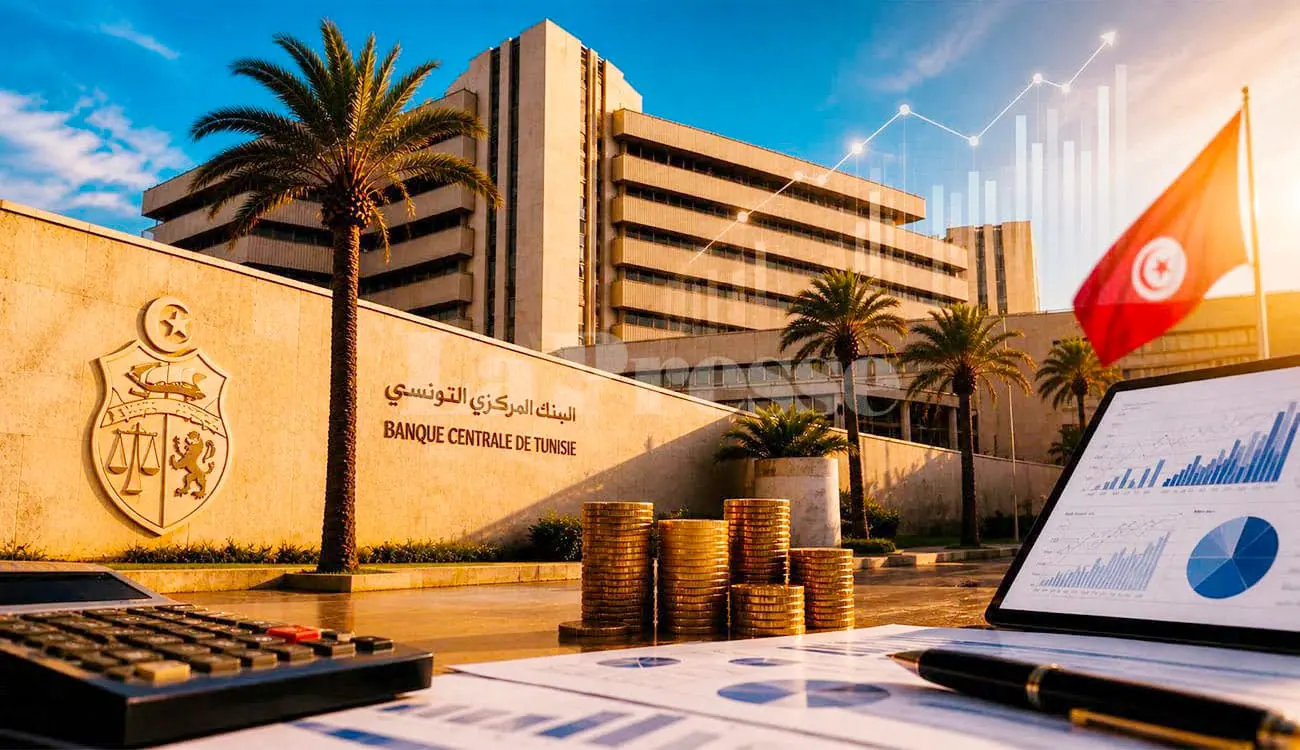
The Central Bank of Tunisia (BCT) has decided to keep its key interest rate unchanged at 7%, citing persistent inflationary pressures and risks surrounding price developments. The decision was made during a meeting on Wednesday, according to a statement released by the bank. The move comes as inflation continues to rise, reaching 5.6% in September, up from 5.4% in August.
The increase in inflation is largely attributed to a 13% rise in the prices of fresh food products over the past year, compared to 11.7% in the previous month. However, the core inflation rate, which excludes fresh food and regulated prices, remained steady at 5.1% for the third consecutive month. This suggests that underlying inflationary pressures are still present in the economy.
The Tunisian economy experienced a slowdown in growth during the second quarter of 2026, with a year-on-year growth rate of 2.3%, down from 2.6% in the first quarter. This decline is largely due to a significant drop in industrial activity. The BCT has expressed concerns over the impact of high global energy prices on the economy, with import costs rising significantly.
The value of energy imports surged to 11.3 billion dinars by the end of August 2026, up from 8.8 billion dinars during the same period in 2025. This increase contributed to a widening of the current account deficit, which reached 4.694 billion dinars, or 2.5% of GDP, during the first eight months of 2026. This compares to a deficit of 2.724 billion dinars, or 1.6% of GDP, during the same period in 2025.
Despite these challenges, the BCT reported that its net foreign exchange reserves stood at 23.7 billion dinars, equivalent to 92 days of imports, as of October 6, 2026. This represents a slight decrease from 24.3 billion dinars and 104 days of imports during the same period in 2025. The bank emphasized the importance of maintaining adequate reserve levels to mitigate the impact of energy price shocks.
The BCT also noted that global energy prices have risen significantly, exceeding previous forecasts made in June 2026. The bank expressed concerns that high energy prices could reduce the economy's maneuvering room and exacerbate its economic and financial vulnerabilities. Inflation risks are seen as tilted to the upside, driven by persistent internal and external pressures.
In response to these challenges, the BCT has pledged to closely monitor price developments, demand, banking liquidity, and external balances. The bank stands ready to take necessary measures to contain inflationary pressures and ensure a sustainable return to lower inflation levels. The central bank's decision to maintain the interest rate at 7% aims to balance the need to control inflation with the need to support economic growth.
Key points
- The Central Bank of Tunisia maintains its interest rate at 7% amid rising inflation and economic challenges.
- Inflation in Tunisia reaches 5.6% in September, driven by higher food and energy prices.
- The bank's decision aims to balance inflation control with support for economic growth.