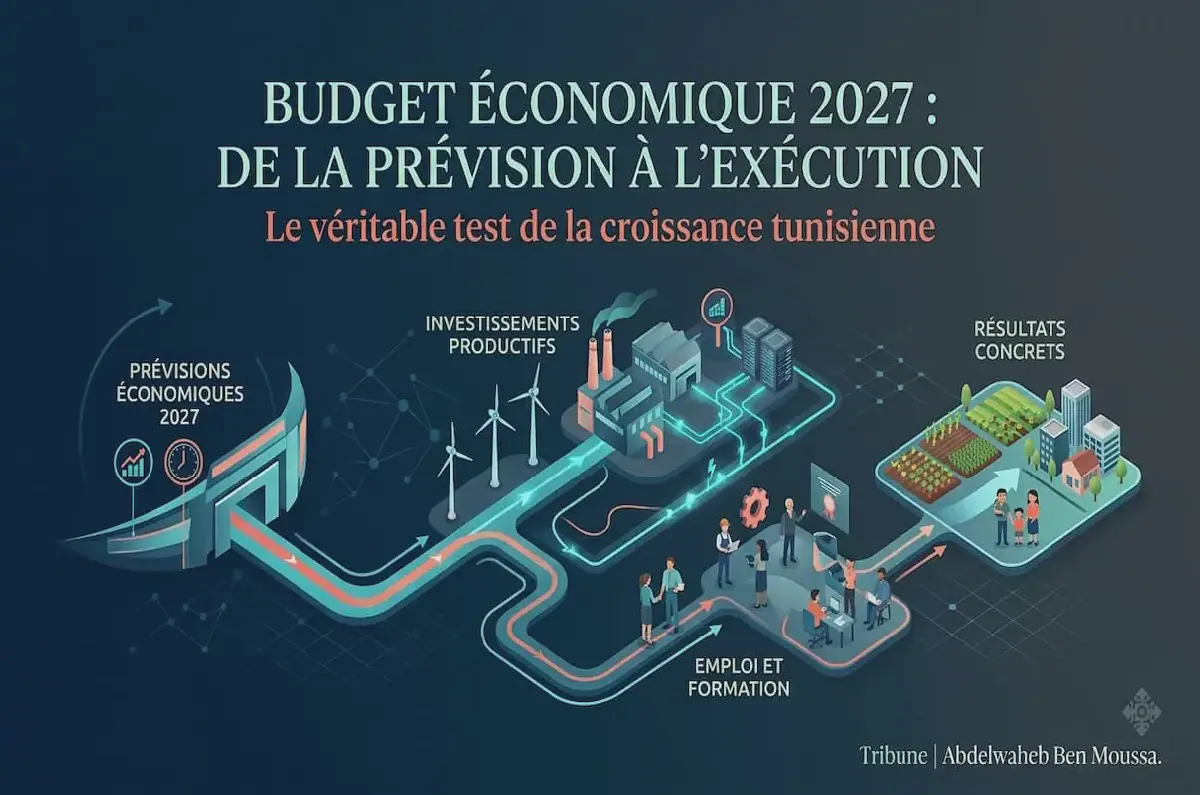
The presentation of Tunisia's 2027 economic budget before parliamentary committees has brought to the forefront a crucial question for the country's economy: to what extent can the announced objectives translate into realized investments, additional productive capacities, and tangible improvements in living conditions? The budget outlines a growth trajectory, with economic growth estimated at 2.7% in 2026 and projected to reach 3.1% in 2027.
According to the budget, the investment rate is expected to rise from 15.5% of GDP in 2026 to 16.4% in 2027, while exports of goods and services are projected to grow by 8%, compared to 7.5% in 2025. These indicators provide useful benchmarks for assessing the country's economic ambitions but do not guarantee the expected dynamic will materialize. The actual challenge of the 2027 economic budget lies in its ability to link national objectives to available means and measurable results.
The downward revision of the 2026 growth forecast to 2.7% highlights the limitations of economic projections. Results depend on internal factors and external developments, such as changes in global demand, energy prices, financing conditions, and climate-related events. The 2027 scenario assumes an oil price of around $80 per barrel, which is a crucial hypothesis for constructing the forecast but not a certainty.
To accurately assess the budget, it is essential to distinguish between achieved results, current estimates, and objectives for the upcoming year. This distinction helps avoid presenting announced targets as accomplished facts and guides the monitoring of economic policy. When hypotheses change, deviations must be identified early to allow for adjustments.
The investment rate targeted for 2027, 16.4% of GDP, reflects a desire to strengthen capital accumulation and productive capacities. However, this global indicator does not provide information on the nature of investments, their progress, or their future contribution to growth. It is crucial to differentiate between announced projects, effectively engaged investments, disbursed financing, and operational realizations.
Foreign direct investments are expected to reach 4 billion dinars in 2026 and 4.8 billion dinars in 2027. Exports of goods and services are also projected to grow by 8% in 2027. These prospects are significant but must be evaluated beyond the announced amounts, focusing on their impact on productive capacities, skills transfer, local suppliers' development, and Tunisian companies' presence in external markets.
The credibility of Tunisia's economic programming depends on the quality of hypotheses and the ability of institutions to monitor their evolution and react to deviations. The 2027 economic budget's success will be determined by its capacity to connect national objectives to available resources and measurable outcomes, ultimately leading to tangible improvements in citizens' lives.
Key points
- The 2027 economic budget outlines a growth trajectory, with a projected 3.1% economic growth and 16.4% investment rate.
- The budget's success depends on its ability to translate objectives into realized investments and improvements in living conditions.
- The credibility of Tunisia's economic programming relies on the quality of hypotheses and the ability to monitor and adjust to changes.