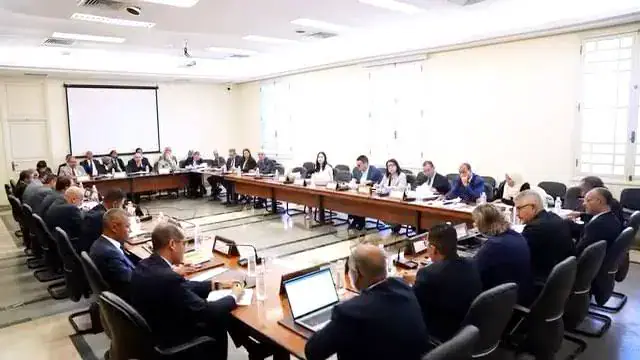
Tunisia's Committee on Administrative Organization, Development, Digitization, and Governance, along with the committee on Development Plans and Major Projects, held a joint session on Monday to discuss the 2027 budget plan for the Prime Minister's office. The proposed budget for 2027 is approximately 377,924 thousand dinars, representing a 0.3% increase. This budget is allocated across six programs: supervision, monitoring, information, communication, training, public sector management, administrative service updates, leadership, and support.
The session began with a presentation by the head of the General Directorate for Public Function at the Prime Minister's office. The presentation covered the office's role in implementing the state's general policy, as per the President's directives, and ensuring the smooth operation of public services. The office is also responsible for executing national and sectoral strategies, developing public financial management, and promoting sustainable development and economic growth.
The presentation highlighted key national references, including the circular on preparing the 2027 state budget, the 2026-2030 development plan, the National Digital Transformation Strategy by 2025, and the strategy for updating the administration and public function. The office's tasks in enhancing government performance, accelerating public project completion, and promoting good governance were also emphasized.
During the discussion, parliament members focused on the progress of administrative modernization, digitalization of services, and procedure simplification. They also inquired about the development of online public procurement and its impact on contract execution. Additionally, members discussed the reform of public institutions, their rehabilitation, and good governance to boost the national economy.
Members also sought information on the evaluation of public-private partnership experiences and called for its activation and expansion. They raised concerns about public contract execution and project delays, particularly large-scale projects. Furthermore, they asked about the criteria for determining priorities and updating the list of stalled projects.
The parliament members also discussed legislative reforms and the progress in reviewing several texts, including the 1983 law on public function, the 2014 decree on public contracts, and the 2001 decree on foreign mission expenses. They emphasized the need for a comprehensive vision to address the situation of precarious workers and improve the distribution of agents in administrative services.
The discussion also touched on the digital platform for implementing Law No. 18 of 2025, which provides exceptional provisions for recruiting graduates with long-term unemployment in the public sector and public function. Members stressed the importance of enhancing cooperation between the executive and legislative branches to accelerate major project completion and promote national development.
Key points
- The 2027 budget plan for the Prime Minister's office is approximately 377,924 thousand dinars.
- The budget plan focuses on six programs, including supervision, monitoring, and public sector management.
- Parliament members emphasized the need for administrative modernization, digitalization of services, and good governance.