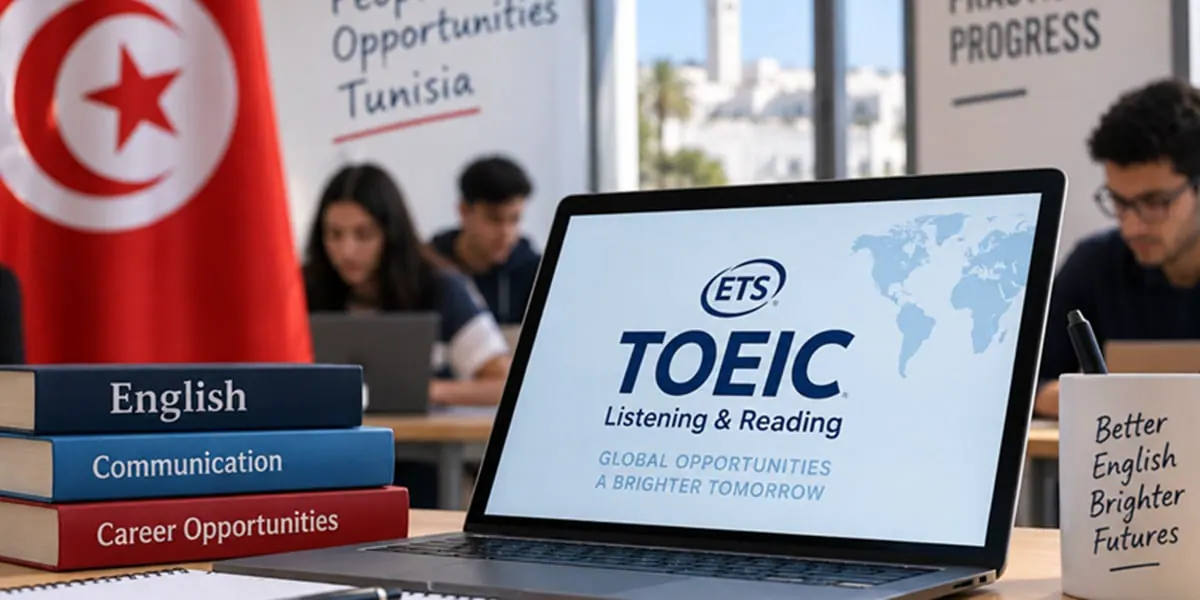
According to the 2025 Report on Test Takers Worldwide published by ETS, Tunisia has achieved a notable score in the TOEIC Listening & Reading test. With an average score of 766 points out of 990, Tunisia ranks sixth among countries and territories listed in the international statistics. This score places Tunisia at the top of African countries included in the report. The ranking reflects the performance of test-takers who sat for the TOEIC Listening & Reading in 2025 and provided associated questionnaire data.
The top scorers in the TOEIC Listening & Reading 2025 are led by Germany with an average score of 851 points, followed closely by Lebanon with 850 points. Belgium ranks third with 780 points, Italy fourth with 776 points, and India fifth with 768 points. Tunisia's score of 766 points positions it just behind India. Other countries that scored lower than Tunisia include Costa Rica with 763 points, Spain with 751 points, Poland with 750 points, the Philippines with 722 points, and France with 719 points.
On the African continent, Tunisia's score significantly surpasses that of other countries listed. Morocco achieved an average score of 717 points, while Algeria scored 713 points. Further down the list, Madagascar scored 697 points, La Réunion scored 635 points, Cameroon scored 614 points, Benin scored 611 points, and Senegal scored 583 points. These scores indicate a considerable variation in TOEIC Listening & Reading performance across different African countries.
It is crucial to interpret Tunisia's performance with caution. The TOEIC Listening & Reading scores do not represent a comprehensive ranking of the general English proficiency level of the population in each country. The data specifically relates to individuals who took the test in 2025 and completed the associated questionnaire. Furthermore, the report only includes categories with at least 500 candidates, which may affect the comparability of scores across countries due to differences in test-taker demographics.
The profile of test-takers globally provides additional context for understanding these results. The majority of candidates, 43%, fall within the 21 to 25 age range. A significant proportion, 58%, are full-time students, and 30% are full-time workers. The primary reasons cited for taking the TOEIC Listening & Reading test include job hunting, academic requirements, and English language learning. These factors highlight the test's close association with educational and professional pursuits.
The score of 766 points achieved by Tunisia indicates a favorable performance for test-takers in 2025. However, it is essential to note that this score should not be extrapolated to represent the English proficiency level of the entire Tunisian population. The test-taker population may not be representative of the broader population due to factors such as the role of TOEIC in universities, companies, and recruitment processes.
The performance of Tunisian test-takers in the TOEIC Listening & Reading 2025 offers insights into their readiness for English language demands in academic and professional settings. As the country with the highest score in Africa, Tunisia sets a notable benchmark for English language proficiency on the continent. Moving forward, it will be important to consider the implications of these findings for education and employment sectors in Tunisia and beyond.
Key points
- Tunisia ranks sixth globally and first in Africa in the TOEIC Listening & Reading 2025 with a score of 766 points.
- The score does not represent a comprehensive ranking of general English proficiency levels of the population in each country.
- The test-taker profile shows 43% of candidates are aged 21-25, with 58% being full-time students and 30% full-time workers.