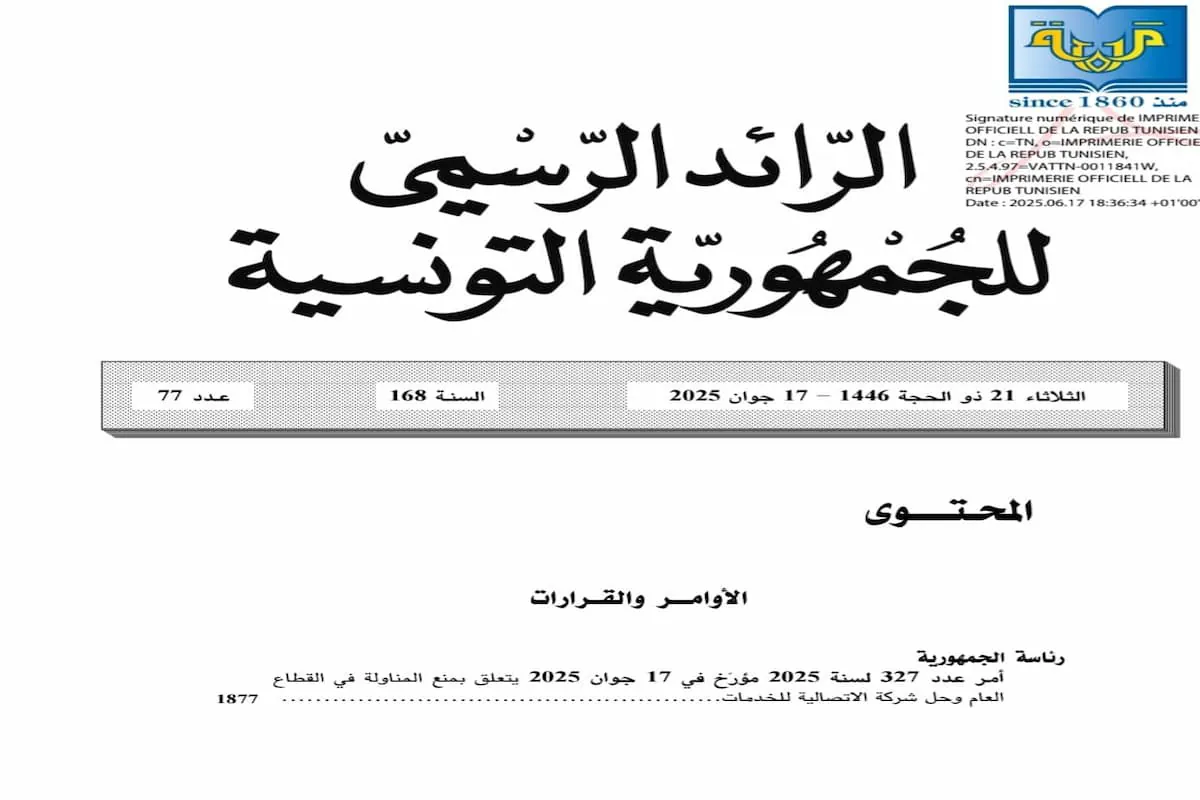
The Tunisian government has officially renewed the National Commission for monitoring and drafting human rights reports. A regulatory text dated September 18, 2026, published in the Official Journal of the Tunisian Republic, designates the members of the national body responsible for coordinating, writing, and presenting reports on human rights. This decision, made by the head of government, modifies the composition of a structure comprising delegates from various ministries and institutions.
The commission includes representatives from the Prime Minister's office, the National Institute of Statistics (INS), and several ministries. Nadia Saya represents the Prime Minister's office, while Slim Khalifa and Imen Kalaï represent the services responsible for relations with constitutional bodies, civil society, and human rights. Anissa Najjar represents the INS. Several ministries have two representatives each, including the Ministries of Justice, Defense, Interior, and Foreign Affairs.
The Ministry of Justice is represented by Badia Jaziri and Mohamed Amine Guebsi, while the Ministry of Defense is represented by Khamis Ghali and Abdel Salam Khemiri. The Ministry of Interior has Fatma Mahdaouani and Ghada Dhaouadi as representatives, and the Ministry of Foreign Affairs, Migration, and Tunisians Abroad has Sami Saïdi and Sarra Chaouani Abidi. Other ministries have one representative each, including the Ministries of Finance, Economy, and Planning.
The commission's renewal aims to strengthen Tunisia's human rights framework. The new composition replaces a previous decision made by the head of government on July 16, 2024. The commission is responsible for monitoring and drafting reports on human rights, as well as following up on recommendations.
The representatives of various ministries and institutions have been designated to ensure a comprehensive approach to human rights. The Ministries of Education, Higher Education, and Research, and Youth and Sports, among others, have representatives on the commission. This includes Sondes Mahfoudh, Meriem Belhaj Kacem, and Nesma Hizami.
The commission's work will likely be closely watched by human rights organizations and the international community. Tunisia has faced criticism in the past for its human rights record, and the renewal of the commission is seen as a step towards strengthening the country's human rights framework. The commission's reports and recommendations will be important in this regard.
The official renewal of the commission is a significant development in Tunisia's efforts to promote and protect human rights. The commission's composition reflects the government's commitment to ensuring a broad and inclusive approach to human rights. The commission's work will be crucial in promoting human rights and fundamental freedoms in Tunisia.
Key points
- The Tunisian government has officially renewed the National Commission for monitoring and drafting human rights reports.
- The commission's new composition includes representatives from various ministries and institutions.
- The renewal aims to strengthen Tunisia's human rights framework and promote human rights and fundamental freedoms.