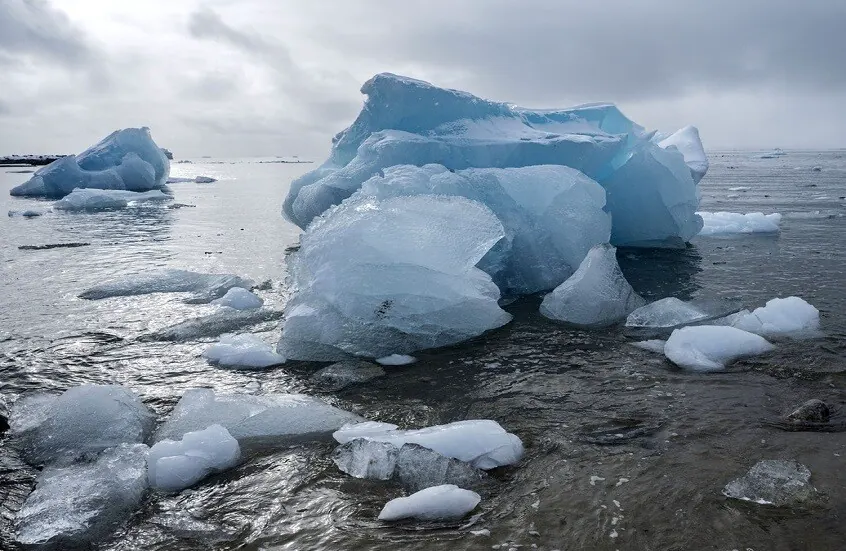
A team of international scientists published a study in the journal "Scientific Data" revealing that Greenland and Antarctica have lost more than 12 trillion tons of ice over the past 47 years. This significant ice loss has resulted in a 31.4 millimeter rise in global ocean levels. Both regions hold the largest portion of the world's freshwater, and if their ice were to completely melt, it could raise ocean levels by tens of meters, posing a catastrophic threat to the planet's inhabitants.
The current rates of ice loss, contributing to rising ocean levels, are cause for concern, especially with the noticeable acceleration of global warming. For instance, the "El Niño" phenomenon recently set a new record, surpassing climate scientists' predictions regarding its peak. The peak occurred several months ahead of schedule, with temperatures in its center reaching 3.05 degrees Celsius, the highest level in the history of meteorological and hydrological records.
The implications of this record are alarming, as 2027 is expected to become the hottest year on record. The impact will be most significant in the Southern Hemisphere, and consequently, in Antarctica. Such high temperatures will accelerate ice melting and continue to raise ocean levels. Scientists have long identified the primary cause of these climate changes as human emissions of carbon dioxide, which continue to increase despite international agreements.
As humanity continues to release greenhouse gases into the atmosphere due to fossil fuel combustion, the ocean absorbs most of the remaining heat in the atmosphere and biosphere. The more thermal energy that enters oceanic systems, the warmer the water becomes, and the more active the currents. In Greenland, this leads to the "Atlantic" phenomenon, where warmer waters from the Atlantic Ocean penetrate further north than ever before, reaching the second-largest ice cover in the world.
In Antarctica, the largest ice cover in the world, the currents surrounding the polar continent are also increasing due to stronger winds and warmer waters. These currents bring warmer waters into contact with ice sheets at the planet's extremities and penetrate deep into glaciers, carrying heat to new areas. Since the 1990s, ice loss has accelerated significantly, with no clear indication of a reversal.
Although records from 2020-2023 may suggest that the situation in the Southern Hemisphere has stabilized, this appears to be a reflection of short-term weather changes. The situation remains a concern, with the potential for continued ice loss and rising ocean levels.
While this situation does not have a direct link to Tunisia, the country's environmental policies and global cooperation will play a crucial role in addressing climate change.
Key points
- - Over 12 trillion tons of ice lost in Greenland and Antarctica in 47 years. - Ice loss contributes to rising ocean levels, posing a threat to global inhabitants. - Human emissions of carbon dioxide identified as primary cause of climate changes.