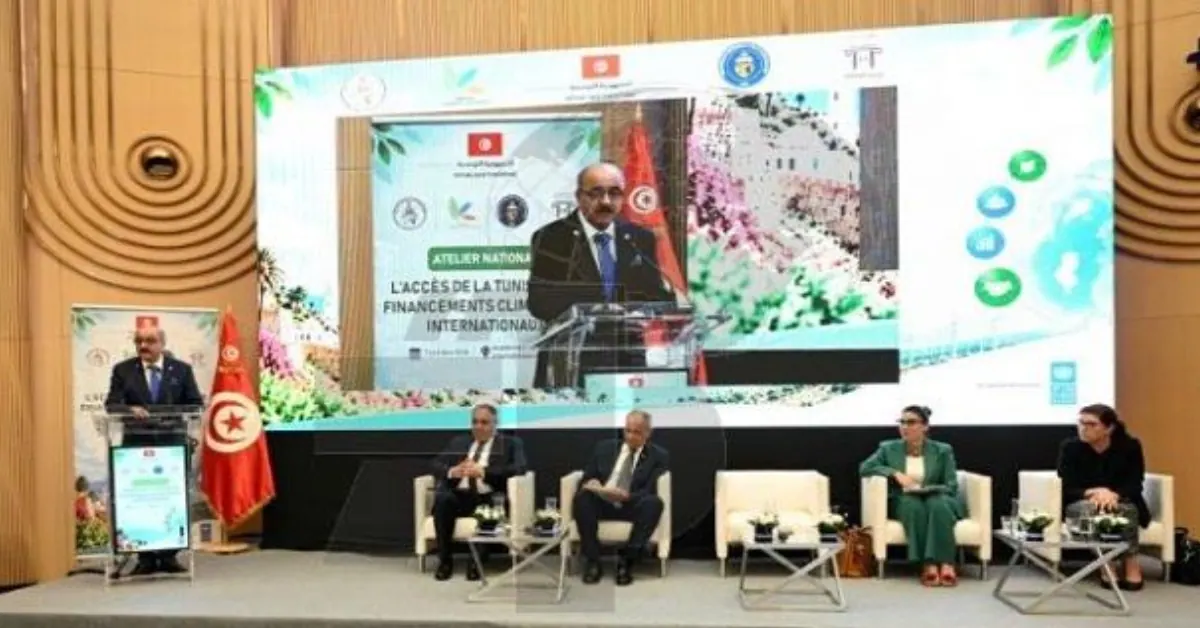
Tunisia is in need of approximately $55 billion, equivalent to 164 billion dinars, to fund the implementation of its nationally determined contribution for the period 2026-2035 in the field of climate change. The country aims to mobilize 74% of these funds at the international level through climate finance mechanisms under the Paris Agreement. This was a key discussion point at a national workshop held at the International Diplomatic Academy in Tunis.
The workshop, titled "Tunisia's Access to Climate Finance," was organized in partnership with the ministries of environment, finance, economy, and planning, with support from the United Nations Development Programme. The event brought together several international partners, including the German Development Cooperation Agency, the Japan International Cooperation Agency, the French Development Agency, the German Development Bank, and the European Bank for Reconstruction and Development.
The main objective of the workshop was to enhance coordination among various stakeholders and partners, and to identify mechanisms to mobilize more resources for Tunisia's climate and development priorities. The country's climate change mitigation and adaptation efforts require significant investment, and the workshop aimed to explore ways to accelerate access to climate finance.
Foreign Minister Mohamed Ali Nafti emphasized that climate finance is not just an environmental issue, but also a development and investment opportunity. He highlighted the evolution of Tunisia's approach to mobilizing finance, shifting from seeking project financing to preparing projects that can attract and integrate multiple funding sources.
Nafti stressed that the goal is to convert climate ambitions into concrete investments and prioritize projects that can be translated into tangible results for the economy, regions, and population. He also underscored the importance of the Tunisian diplomatic network in mobilizing climate and environmental finance.
The minister noted that the financial resources mobilized so far to achieve Tunisia's climate goals are still below the country's potential. He called for a change in approach, seeking to mobilize more resources through different means and exploring mechanisms to convert debt into development projects.
The national workshop provided a platform for stakeholders to discuss ways to address the funding gap and accelerate Tunisia's access to climate finance. The country's ability to mobilize the required funds will be crucial in implementing its climate contribution and achieving its development goals.
Key points
- Tunisia needs $55 billion to fund its climate contribution from 2026-2035.
- The country aims to mobilize 74% of these funds at the international level through climate finance mechanisms under the Paris Agreement.
- The workshop aimed to enhance coordination among stakeholders and identify mechanisms to mobilize more resources for Tunisia's climate and development priorities.