The Tunisian government has estimated that it needs approximately $55 billion to finance its Nationally Determined Contribution (NDC 3.0) from 2026-2035. This amount is equivalent to nearly 164 billion dinars. About 74% of this funding is expected to be mobilized internationally through climate finance instruments established under the Paris Agreement.
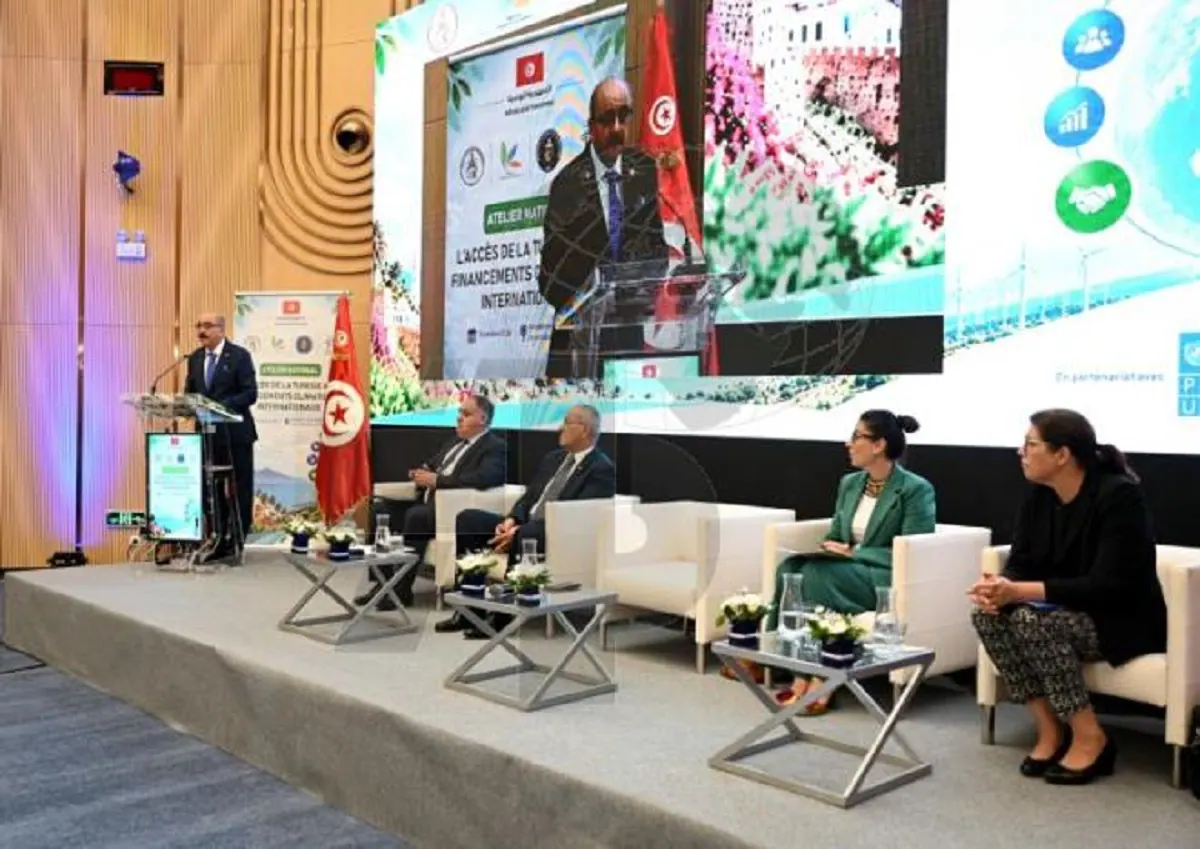
A national workshop was held at the International Diplomatic Academy in Tunis to discuss ways to accelerate Tunisia's access to climate financing. The workshop, organized by the Ministries of Foreign Affairs, Environment, Finance, and Economy and Planning, with support from the United Nations Development Programme (UNDP), aimed to strengthen coordination between national actors and foreign partners.
The workshop brought together various stakeholders, including representatives from the UNDP, GIZ, JICA, AFD, and KfW, BERD. The goal was to identify mechanisms to mobilize more resources for Tunisia's climate and development projects.
Foreign Minister Mohamed Ali Nafti emphasized that climate financing is not only an environmental issue but also a development, investment, and economic transformation issue. He highlighted the evolution of Tunisia's approach to mobilizing financing, shifting from seeking funding for individual projects to building bankable projects that can attract multiple sources of funding.
Minister Nafti also stressed the importance of transforming climate ambitions into concrete investments, priorities into projects, and projects into tangible results for the economy, territories, and populations. He noted that mobilizing climate and environmental financing has become a key aspect of Tunisia's diplomacy.
Environment Minister Habib Abid called on foreign partners to support the Green Belt program, which aims to restore 260,000 hectares of degraded land, sequester significant amounts of carbon, and create thousands of green jobs in rural areas. He emphasized that climate change is no longer just an environmental challenge but a threat to water, food, and energy security, as well as the country's coastline and natural resources.
The Tunisian government has set an ambitious target to reduce its carbon intensity by 31% by 2035. The country also aims to reduce its net greenhouse gas emissions by 34% by 2035 compared to 2010 levels. The acceleration of the energy transition, through the development of renewable energies and energy efficiency, is a key pillar of Tunisia's climate transition.
Key points
- Tunisia requires $55 billion to implement its Nationally Determined Contribution (NDC 3.0) from 2026-2035.
- The country aims to reduce its carbon intensity by 31% and net greenhouse gas emissions by 34% by 2035.
- The Green Belt program aims to restore 260,000 hectares of degraded land and create thousands of green jobs in rural areas.