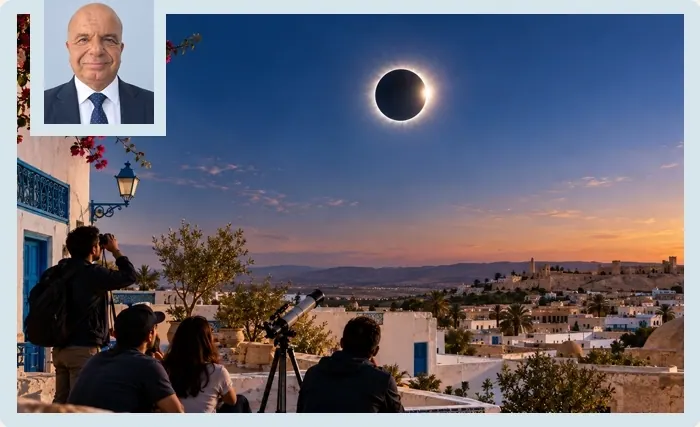
On August 2, 2027, Tunisia will experience a rare astronomical event: a total solar eclipse visible in several regions, including Kasserine, Kairouan, and Sfax. The eclipse will last approximately 5 minutes and 28 seconds in Kasserine. This phenomenon presents an opportunity for Tunisia to develop its astro-tourism industry, which could generate revenue and create jobs. According to experts, the country's scientific infrastructure, including the Cité des Sciences de Tunis, can be leveraged to support this initiative.
Other countries have successfully capitalized on astronomical events to boost tourism. For example, Spain has established an inter-ministerial committee to coordinate its response to the 2026-2028 eclipse cycle, while Egypt has set up a committee to prepare for the 2027 eclipse. Chile's 2019 eclipse drew over 307,000 visitors to the Coquimbo region, generating more than 56 billion pesos in revenue. Tunisia can learn from these examples and develop its own strategy to maximize the economic benefits of the eclipse.
The Tunisian government can utilize the eclipse as a catalyst for the development of astro-tourism in regions that require new economic opportunities. The Cité des Sciences de Tunis and its network, particularly in Kasserine, can serve as a foundation for this initiative. Additionally, Kasserine and Kairouan can become hubs for astro-tourism, offering activities such as stargazing, photography, and astronomy nights. This can create new revenue streams for local businesses, including hotels, restaurants, and tour guides.
The National Tourist Office of Tunisia (CNCT) can contribute to the development of astro-tourism by creating a map of light pollution using satellite data from NASA and NOAA. This will help identify areas with optimal viewing conditions for astronomical events. The NASA data will also be useful for studying night lighting and planning astronomical sites. By taking a proactive approach, Tunisia can establish itself as a prime destination for astro-tourism.
A calendar of astronomical events has been proposed to transform the 2027 eclipse into a permanent tourist destination. The calendar highlights several notable events, including the 2027 lunar eclipse, the Perseid meteor shower, and the 2028 total lunar eclipse. By promoting these events, Tunisia can attract visitors throughout the year and establish a sustainable astro-tourism industry.
The development of astro-tourism in Tunisia requires a multi-faceted approach that involves various stakeholders, including government agencies, local businesses, and scientific institutions. By working together, these stakeholders can create a unique and compelling experience for visitors, leveraging Tunisia's natural resources and scientific expertise. The 2027 eclipse presents a rare opportunity for Tunisia to showcase its potential as a hub for astro-tourism.
As Tunisia prepares for the 2027 eclipse, the government and private sector must work together to develop infrastructure and services that cater to the needs of astro-tourists. This includes providing accommodations, transportation, and guided tours. By investing in these areas, Tunisia can ensure that the 2027 eclipse is a success and that the country's astro-tourism industry continues to grow in the years to come.
Key points
- Tunisia is leveraging the 2027 solar eclipse to develop its astro-tourism industry and boost local economies.
- The 2027 eclipse will be visible in several regions, including Kasserine, Kairouan, and Sfax.
- A calendar of astronomical events has been proposed to promote Tunisia as a year-round destination for astro-tourism.