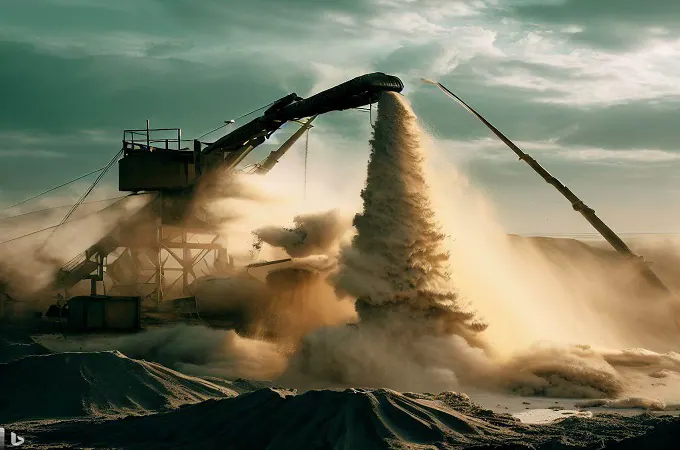
Tunisia is turning its attention to critical minerals, a group of essential raw materials for modern technologies, with the Instance tunisienne de l'investissement (TIA) recently holding a closed-door meeting to discuss the potential for investment in this sector. The TIA has stated that Tunisia has a real investment potential in critical minerals, including phosphate, lithium, and copper, but has not provided further details.
According to reports, Tunisia has significant reserves of phosphate, with over 3 billion tonnes confirmed, although only 4 million tonnes are produced annually. The country also has large reserves of lithium, which can be extracted from salt, a product that is already exported in large quantities. With the global demand for critical minerals on the rise, Tunisia sees an opportunity to capitalize on its resources and attract foreign investment.
The phosphate sector is seen as a key area for growth, with the global price of phosphate quadrupling over the past three years due to factors such as the COVID-19 pandemic, the Russia-Ukraine war, and climate change. Tunisia's phosphate reserves are estimated to be worth billions of dollars, and increasing production and diversifying export markets could provide a significant source of foreign currency for the country.
The recent opening of the phosphate sector to private investors is seen as an opportunity for growth, with the Australian company PhosCo being granted a concession to exploit 166.6 million tonnes of phosphate in the Kasserine region. The project, known as Gassat, has also attracted interest from US companies, which are being encouraged by a $1.5 million subsidy from the US Department of State and the US Embassy in Tunisia.
In addition to phosphate, Tunisia also has significant reserves of lithium, which can be extracted from salt. The country produces around 1.8 million tonnes of salt per year, with 10% of this being consumed locally. However, the majority of the salt is exported in its raw form, with the Compagnie générale des Salines de Tunisie (COTUSAL), a French-owned company, being one of the main exporters.
The Tunisian government is seeking to transform its critical minerals sector, with the recent granting of a permit to the Gulf Care Company Branch Tunisia to search for mineral substances in the Chott El Gharsa region. The government is expected to be mindful of the technological value of lithium and ensure that any investment in this sector leads to the development of industrial units in Tunisia.
The development of Tunisia's critical minerals sector could have significant economic benefits for the country, including the creation of jobs and the generation of foreign currency. With the right investment and policies in place, Tunisia could become a major player in the global critical minerals market, and reap the rewards of its natural resources.
Key points
- Tunisia has significant reserves of critical minerals, including phosphate and lithium.
- The country is seeking to attract foreign investment to develop these resources.
- The development of the critical minerals sector could have significant economic benefits for Tunisia.