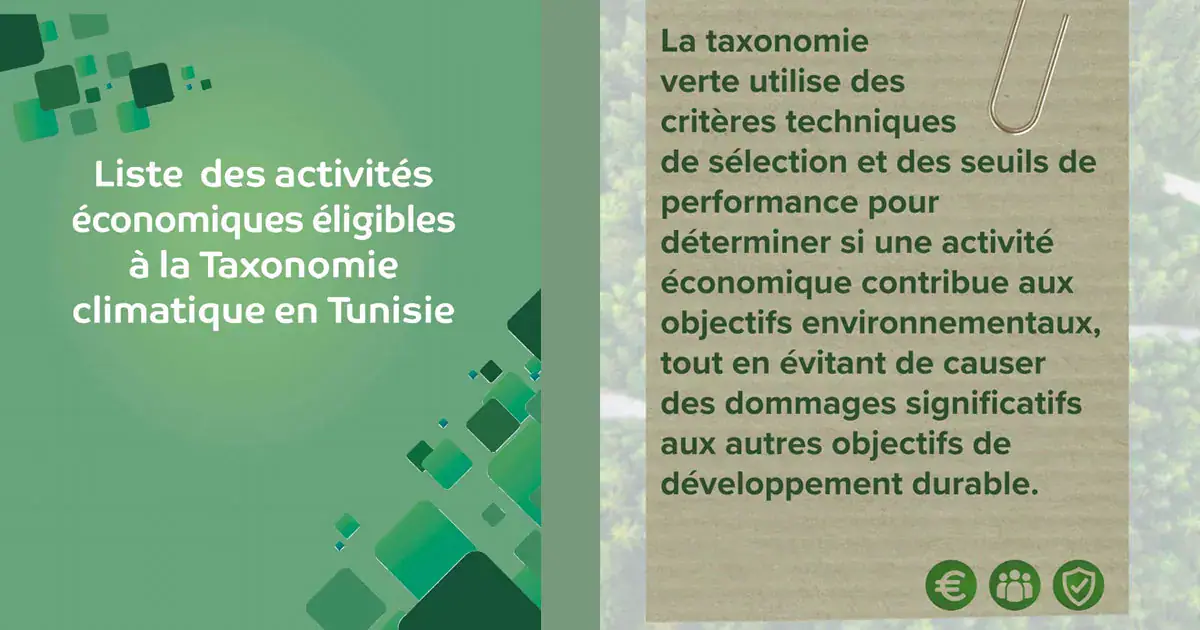
The Tunisian government has launched a national climate taxonomy, a new reference tool aimed at guiding public and private investments towards ecological transition, reducing greenhouse gas emissions, and adapting to climate change. This initiative was developed by the Ministry of Environment in collaboration with the Banking and Financial Council, with support from the United Nations Development Programme, Climate Promise, and the Global Environment Facility.
The taxonomy identifies 100 economic activities that contribute to climate change mitigation, categorized into three groups: 25 enabling activities, 22 low-carbon emission activities, and 53 transition activities. A particular focus is placed on the agricultural sector, which is strategic for the country's food security and highly exposed to drought effects.
The agricultural activities identified include organic and conservation agriculture, legume cultivation, degraded land restoration, agroforestry, and sustainable forest management. For climate change adaptation, the document also provides for the development of drought- and heat-resistant crops, drip irrigation and precision irrigation, wetland restoration, and integrated watershed management.
The fisheries and aquaculture sectors are also addressed, with measures such as protecting port infrastructure from sea-level rise, developing closed-circuit fish farming, and researching more resilient species to rising marine temperatures. The taxonomy also encompasses renewable energies, energy efficiency, electric mobility, rail transport, waste recycling, and the progressive decarbonization of manufacturing and agri-food industries.
The goal of this initiative is to provide banks, companies, international investors, and public institutions with common criteria for environmental project evaluation, promoting the mobilization of capital towards activities compatible with national climate priorities and enhancing transparency in sustainable finance.
This initiative aligns with Tunisia's commitments under the Paris Agreement, particularly the objective of reducing the carbon intensity of the economy by 45% by 2030, compared to 2010 levels, as stated in the updated national contribution in 2021. The taxonomy is expected to play a crucial role in achieving this goal.
By providing a clear framework for green investments, Tunisia aims to attract more funding towards climate-friendly projects and activities, ultimately contributing to a more sustainable and resilient economy. The country's efforts to address climate change and promote sustainable development have been recognized internationally, and this new taxonomy is expected to further enhance its reputation as a leader in the region.
Key points
- Tunisia has identified 100 economic activities that contribute to climate change mitigation, including 25 enabling activities, 22 low-carbon emission activities, and 53 transition activities.