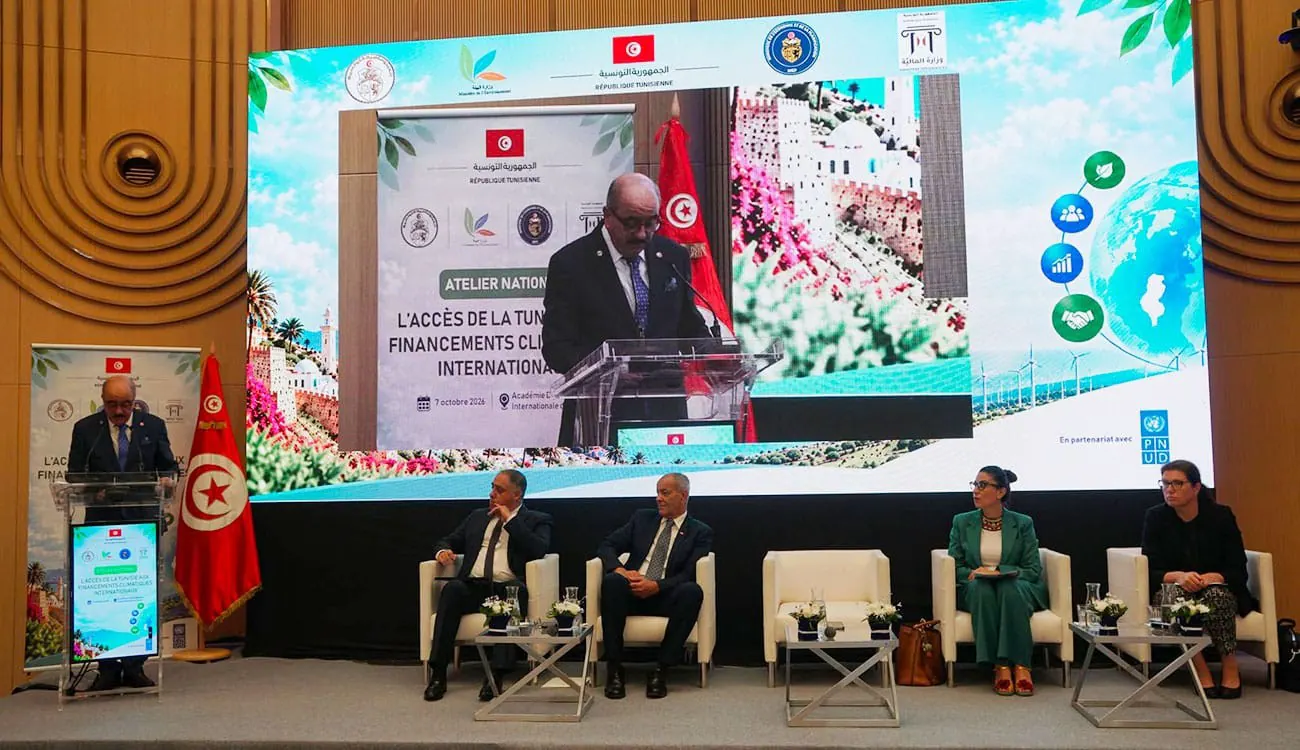
The Tunisian government recently hosted a national workshop on accessing climate financing, bringing together ambassadors, international organization representatives, and technical and financial partners. The event, held at the International Diplomatic Academy in Tunis, was organized by the Ministry of Foreign Affairs, Migration, and Tunisians Abroad, in collaboration with the Ministries of Environment, Finance, Economy, and Planning, and supported by the United Nations Development Programme (UNDP). The workshop aimed to strengthen coordination between national actors and foreign partners to identify mechanisms for mobilizing financial resources for climate and development projects.
Tunisia needs approximately $55 billion (around 165 billion dinars) to fund its Nationally Determined Contribution (NDC) 3.0 from 2026-2035, with 74% of this amount expected to be mobilized internationally through climate finance instruments established under the Paris Agreement. The country's diplomacy and environmental efforts are crucial in securing this funding. The workshop provided a platform for stakeholders to discuss ways to accelerate access to climate financing and explore mechanisms for converting debt into development projects.
Foreign Minister Mohamed Ali Nafti emphasized the importance of climate and environmental diplomacy in ensuring better national coordination and identifying mechanisms to access available climate financing. He stressed that climate financing is not solely an environmental issue but also a development, investment, and economic transformation matter. Nafti highlighted the evolution of Tunisia's approach to mobilizing financing, as per the instructions of President Kais Saied, and noted that the workshop aimed to send a message to partners and funders about the country's efforts in this regard.
Environment Minister Habib Abid called on foreign partners to support the Green Belt program, which aims to achieve concrete results by 2030 in several governorates. The program involves restoring around 260,000 hectares of degraded land, sequestering significant amounts of carbon, and creating thousands of green jobs in rural areas. Abid emphasized the multiple challenges posed by climate change, including threats to water, food, and energy security, as well as the coast and natural resources.
The ministers and representatives present at the workshop discussed various projects and programs underway with different partners, including photovoltaic stations and coastal protection initiatives. Rana Taha, UN Resident Coordinator in Tunisia, highlighted the importance of climate financing in supporting development and growth in the country. She emphasized the need for complementarity between different actors to achieve just and inclusive development and leverage international cooperation.
The workshop also explored mechanisms for converting debt into development projects and accelerating the establishment of a carbon authority in Tunisia. This authority would enable the country to benefit from financing mechanisms under Article 6 of the Paris Agreement. The country's potential for attracting investments and partnerships was also highlighted, with stakeholders emphasizing the need for a coordinated approach to mobilize financial resources.
The national workshop on accessing climate financing concluded with a renewed focus on strengthening coordination between national actors and foreign partners. The event provided a platform for stakeholders to discuss ways to address the challenges posed by climate change and explore opportunities for sustainable development. Tunisia's efforts to access climate financing and implement its NDC 3.0 are expected to continue, with the country's diplomacy and environmental efforts playing a crucial role in securing the necessary funding.
Key points
- Tunisia requires $55 billion to fund its national climate contribution from 2026-2035.
- The country needs to mobilize 74% of this amount internationally through climate finance instruments.
- The workshop aimed to strengthen coordination between national actors and foreign partners to identify mechanisms for mobilizing financial resources for climate and development projects.