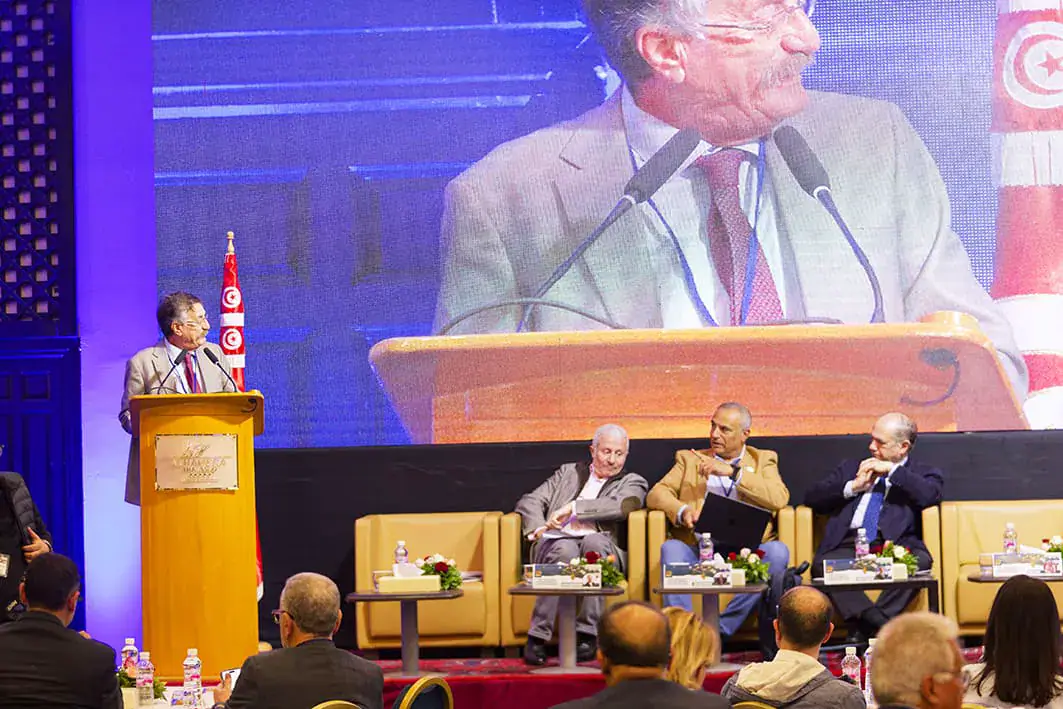
The closing ceremony of the 28th Realities International Forum in Tunisia was marked by expressions of gratitude from Taïeb Zahar to all participants, speakers, partners, and organizers who contributed to the event's success. He specifically thanked the scientific committee, comprising experienced former ministers such as Afif Chelbi, Slim Tlatli, and Hakim Ben Hammouda, for their dedication and valuable contributions. Zahar also acknowledged the support of European friends of Tunisia, whose involvement continues to grow in pursuit of higher quality.
A key highlight of the closing ceremony was the emphasis on transmission and the involvement of young people in the forum. At the initiative of the scientific committee, students and doctoral students were invited to attend the forum's proceedings, listen to experts, and participate in discussions on Tunisia's future and its relations with the European Union. Taïeb Zahar stressed the importance of youth participation in future forums, announcing plans to invite as many doctoral students as possible to make their participation a strategic orientation for the Realities Group.
Kader Abderrahim, a research director at the Institute for Prospective and Security Studies in Europe and a lecturer at Sciences Po in France, analyzed the forum's discussions and identified several key takeaways. He emphasized the need to recognize Tunisia as a full-fledged strategic partner, rather than just a periphery of Europe or a territory for managing migration flows or energy projection. Abderrahim called for a partnership based on reciprocity, respect for mutual interests, and economic sovereignty.
The discussions also highlighted the need to move beyond the migration issue and consider the Mediterranean as a vector of rapprochement between peoples through academic exchanges, researcher mobility, training, and professional opportunities. A sustainable cooperation requires addressing the root causes of migration, such as unemployment, territorial inequalities, and lack of prospects. The debates also emphasized that the Mediterranean's future cannot be considered without taking into account its broader geopolitical environment.
The 28th Realities International Forum published recommendations on geo-economy, industrial policy, energy transition, and technological challenges. The participants noted that the advent of geo-economy is transforming international relations, particularly in the Mediterranean. Despite the changes, the South of the Mediterranean still attracts the interest of major international financial institutions, which continue to invest in the region.
The recommendations emphasize the need for Tunisia to rebuild its industrial policy around competitiveness pacts and public-private partnership tools to restore confidence among entrepreneurs. The country is also called upon to work towards a new partnership with the European Union, focused on co-production, research and development, innovation, and energy transition. The Pact for the Mediterranean should evolve to provide adequate financing tools for this partnership.
The forum's message was clear: the Mediterranean should not become a border between a protected North and a South seeking to survive. It should become a space for projects, circulation, knowledge, and shared prosperity. The participants called for less verticality and more partnership, less crisis management and more anticipation, and fewer promises and more concrete commitments. The success of the Pact for the Mediterranean will be measured by tangible achievements, jobs created, skills transmitted, and prospects offered to populations on both sides.
Key points
- The 28th Realities International Forum emphasized the need for a stronger and more equal partnership between Europe and Tunisia.