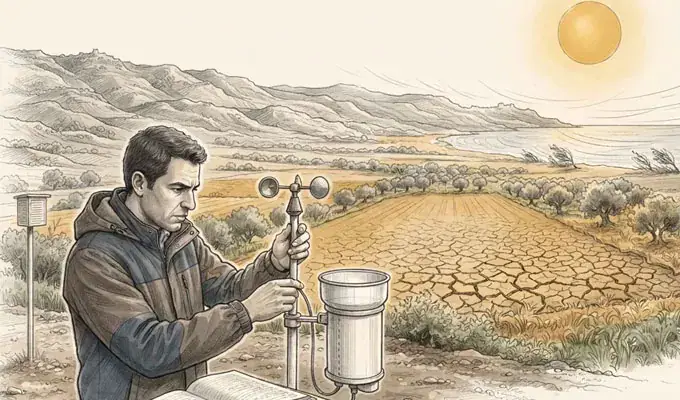
Tunisia's October 2026 was characterized by temperatures generally higher than the country's climatological normals. The national average temperature was 22.5°C, 0.7°C above the 21.8°C normal. This increase was observed in both maximum and minimum temperatures, with rises of 0.5°C and 0.9°C, respectively. Regional temperature variations were notable, ranging from 17.1°C in Thala to 24.9°C in Tozeur.
The warmer temperatures were widespread across the country, with the national average temperature calculated from 26 main stations reaching 22.5°C, 0.7°C above the reference average of 21.8°C. Maximum temperatures averaged between 21.9°C in Thala and 30°C in Tozeur, while the national average maximum temperature was 27.6°C, 0.5°C above the reference average. Minimum temperatures ranged from 12.3°C in Thala to 21°C in Mahdia, with a national average of 17.5°C, 0.9°C above the reference average.
In contrast to the warmer temperatures, October 2026 was marked by a significant and generalized rainfall deficit across Tunisia. The total rainfall recorded at the considered stations was 482.8 mm, compared to a normal of 1024.3 mm, representing a global deficit of approximately 52.9%. Regional disparities were observed, with the most significant rainfall recorded in the far north, particularly in Tabarka, which received 117 mm, close to its normal of 116.2 mm.
The rainfall deficit was particularly pronounced in other regions, including Cap Bon and the Center-East, where Nabeul recorded only 8.3 mm against a normal of 60 mm, and Monastir received 8.6 mm against 54.9 mm. In the Center, rainfall was very weak, with Kairouan receiving 2.6 mm, Mahdia 4.4 mm, and Sidi Bouzid 1.8 mm. The South also experienced a deficit, with Gabès recording 6.5 mm against 30.7 mm and Matmata only 0.4 mm against 22.8 mm.
Despite the overall deficit, some regions received more rainfall than usual, such as Djerba, which recorded 36.2 mm, exceeding its normal of 31.1 mm. In addition to the rainfall deficit, October 2026 was marked by episodes of relatively strong winds, particularly in the North and Northeast regions. The maximum wind speed reached 90 km/h in Kélibia, 86.4 km/h in Bizerte, and 82.8 km/h in Jendouba and Thala.
The strong winds were not limited to these regions, with Tabarka experiencing 4 days with wind speeds above 60 km/h, Bizerte and Béja experiencing 3 days, and Jendouba, Thala, and Jerba experiencing 2 days. In other regions, these episodes were less frequent. The INM's monthly climate bulletin reported these weather patterns, providing insights into Tunisia's climate in October 2026.
The warmer temperatures and rainfall deficit in October 2026 may have implications for various sectors, including agriculture and water resources. According to the INM's report, these conditions are part of a larger climate trend in Tunisia, which is experiencing changes in temperature and precipitation patterns.
Key points
- Tunisia's October 2026 was characterized by warmer temperatures and a significant rainfall deficit.
- The national average temperature was 22.5°C, 0.7°C above the normal.
- The total rainfall recorded was 482.8 mm, approximately 52.9% below the normal.