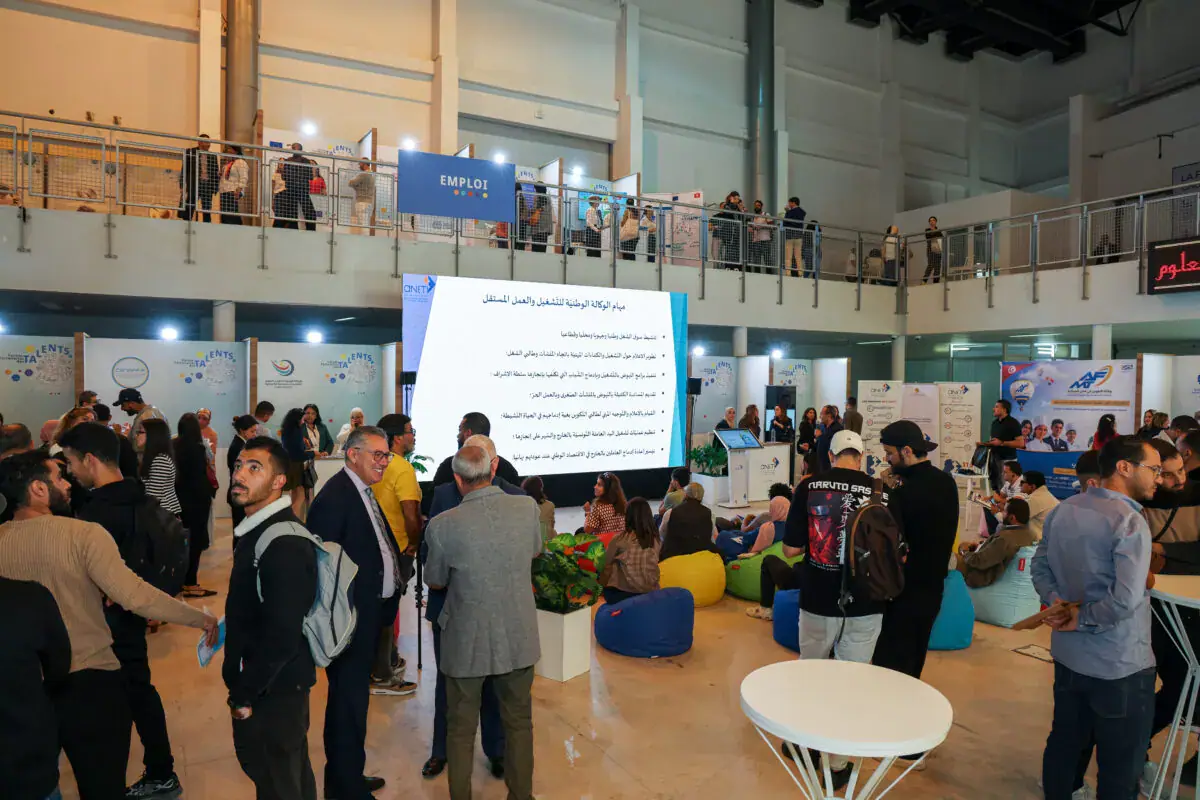
The Tunisia-EU Talent Partnership, launched three years ago, has made significant strides in its mission to develop skills and facilitate professional mobility between Tunisia and the European Union. On November 11, 2026, over 400 participants, including job seekers, learners, and students, gathered at the Cité des sciences in Tunis for the first Talent Partnership Forum. The event provided a platform for participants to learn about the opportunities offered by the partnership, understand the mechanisms of professional mobility, and identify paths that match their profiles and projects.
At the heart of the partnership lies a strategic priority: developing skills and adapting training to the real needs of the labor market. To achieve this, a cooperation portfolio of nearly €45 million has been mobilized to support activities and projects associated with the partnership. For Tunisia, this involves continuous European support to better align vocational training, university curricula, and business demand. Since 1996, Tunisia has relied on a competency-based approach and a formalized national repertoire, enriched by the RTMC reference framework used by the employment services of ANETI.
The partnership has also focused on modernizing the RTMC reference framework to better reflect the evolution of professions and sought skills, and to strengthen the adequacy between candidate profiles and labor market needs. Initiatives such as the "Savoir agir" program, which has already trained over 1,400 teachers, have been launched to address identified weaknesses, particularly among license graduates. Co-construction of programs with the private sector has also yielded positive results, with short training courses with company immersion leading to "trainer" labels in the hotel industry.
To optimize talent orientation, a detailed understanding of the labor market is essential. Within the framework of the Tunisia-EU Talent Partnership, the National Observatory for Employment and Qualifications (ONEQ) has received support to establish a prospective monitoring cell and carry out a mapping of skill needs in several priority sectors. This approach enables informed decision-making and better anticipation of labor market trends. The sectors concerned include agriculture, personal services and care, transportation and logistics, industry, tourism, and catering.
The partnership has also facilitated the recognition of qualifications and the portability of skills. Thanks to the rapprochement of certification frameworks and the work of the MED Skills Tracker within the framework of the Pact for the Mediterranean, Tunisia and the EU have laid the technical and political foundations for a genuine valorization of professional paths. Furthermore, over 6,000 professional mobility projects are currently underway within the framework of the Tunisia-EU Talent Partnership.
Despite progress, challenges persist, such as visa procedures, accommodation, and access to information. To consolidate these achievements, the main challenge now is to transform these pilot projects into sustainable mechanisms with stable public-private co-financing. Upcoming steps include the organization of sectoral recruitment forums between Tunisia and the EU and the creation of a joint working group to pilot the follow-up of the roadmap.
The partnership has yielded positive results, with several EU member states actively involved in the effort. For example, Germany has issued over 5,000 employment visas in 2025, while France has issued over 15,000 talent passports. Italy has also granted over 16,000 work visas for the period 2024-2026. The partnership aims to create a win-win situation for both Tunisia and the EU, promoting professional mobility and addressing labor market needs.
Key points
- The partnership has mobilized a cooperation portfolio of nearly €45 million to support activities and projects associated with the partnership.
- Over 6,000 professional mobility projects are currently underway within the framework of the Tunisia-EU Talent Partnership.
- The partnership has yielded positive results, with several EU member states actively involved in the effort.
Reporting sources
- Partenariat des talents Tunisie-UE : bilan et perspectives vers une mobilité durable · L'Économiste maghrébin