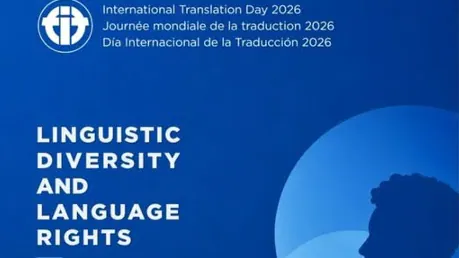
Tunisia celebrated World Translation Day on September 30, with the Ministry of Cultural Affairs releasing a statement to commemorate the occasion. The International Federation of Translators has chosen the theme "Linguistic Diversity and Linguistic Rights: The Power of Being Understood" for this year's celebrations. The Ministry emphasized the importance of translation in enriching cultural and scientific life, promoting communication between languages and civilizations, and fostering human dialogue and rapprochement.
The Ministry of Cultural Affairs highlighted Tunisia's commitment to linguistic diversity since independence, starting from the education system. This commitment has not compromised the country's mother tongue, Arabic. Tunisia's cultural movement is characterized by diversity, resulting from its creators' openness to various cultural experiences and languages. This openness has contributed to building a national cultural identity that is modern and rooted in its original heritage.
The Ministry emphasized that Tunisia believes that peoples have the right to learn about world languages, particularly those that produce knowledge and enrich local and national culture. The country has a unique cultural coexistence between the local dialect, Arabic, and various foreign languages. This linguistic diversity has enabled Tunisia to preserve its poetic heritage and promote literature in Arabic and foreign languages.
The Ministry of Cultural Affairs stressed that understanding between people speaking different languages is a strength that goes beyond mere communication in a single language. This strength lies in the ability to comprehend two or more cultures, switch between multiple linguistic shores, and enrich the local language with productions from other languages. In a society striving for creative knowledge and renewable science, accessing global cultural and scientific production requires navigating multiple linguistic rivers.
Translation is considered a means of bridging cultures, transferring national fingerprints beyond narrow borders, and facilitating the exchange of ideas and experiences between cultures. The translator plays a crucial role in this process, acting as a navigator who guides language from one shore to another, carrying knowledge, ideas, and experiences from one culture to another, and contributing to building bridges of understanding between nations.
The Ministry of Cultural Affairs praised the efforts of translators, who work to make knowledge and cultures accessible to all. By celebrating World Translation Day, Tunisia acknowledges the importance of linguistic diversity and cultural exchange in building a more interconnected and understanding world. The country's commitment to translation and linguistic diversity reflects its aspiration to be a hub for cultural and scientific exchange.
As Tunisia continues to promote linguistic diversity and cultural exchange, it recognizes the significance of translation in fostering global understanding and cooperation. By embracing multiple languages and cultures, Tunisia aims to strengthen its position as a bridge between different civilizations and to contribute to the enrichment of human knowledge and culture.
Key points
- Tunisia celebrates World Translation Day, emphasizing linguistic diversity and cultural exchange.
- The Ministry of Cultural Affairs highlights the importance of translation in enriching cultural and scientific life.
- Tunisia promotes linguistic diversity and cultural exchange to build a more interconnected and understanding world.