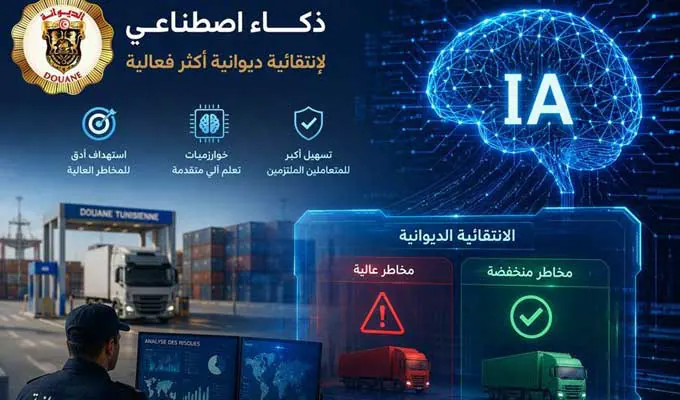
The Tunisian Ministry of Finance and General Directorate of Customs are set to harness the power of artificial intelligence (AI) and machine learning to analyze data and process declarations and high-risk files. This move aims to focus control efforts on priority cases while using AI as a decision-making tool that complements human expertise. The initiative was unveiled at a national seminar organized by the National School of Finance and the National School of Customs in Tunis.
The seminar, titled "The Challenges of Artificial Intelligence and the Areas of Intervention of the Ministry of Finance: The Role of Training Institutions," brought together experts to discuss the applications of AI in customs and taxation. Issam Fassatoui, Director of Risk Management at the General Directorate of Customs, presented a simulation of a machine learning model that identified potential risks in customs data from 2025. The model successfully detected additional amounts totaling 96.9 million dinars, with a detection rate of 49.23%.
In the fiscal sphere, Salah Meddeb, Director General of the Ministry of Finance's IT Center, outlined a project to utilize Big Data and machine learning for tax verification. The goal is to better target high-risk files, detect informal economy activities, and identify unregistered taxpayers and complex fraud schemes. The project, currently in the tendering phase, will be implemented over the next year using local infrastructure and open-source tools.
Moez Daldoul, Director at the General Directorate of Taxes, highlighted the benefits of digitalization in reducing manual and repetitive tasks, allowing for more time to focus on control and analysis activities. He reported that the number of remote declarants has reached 157,000, while the number of employer declarations submitted on time has increased to 87,000, up from 57,000 at the end of the previous year. Automation has resulted in a gain of nearly 8,000 working days.
The integration of AI is expected to enhance data consistency, cross-transaction verification, and risk-based file classification. Daldoul emphasized that this evolution requires strengthening agent competencies in data analysis and statistics, with final decision-making authority resting solely with the agent. The use of AI will not replace human expertise but rather support it.
The Tunisian government is committed to investing in AI and digital technologies to improve the efficiency and effectiveness of its customs and taxation systems. This move is part of a broader effort to modernize and enhance the country's economic governance. The implementation of AI solutions is expected to have a positive impact on revenue collection and the business environment.
As Tunisia continues to leverage AI in customs and taxation, the country is likely to see improved compliance, reduced tax evasion, and enhanced economic competitiveness. The government's focus on digitalization and AI adoption reflects its commitment to harnessing technology to drive economic growth and development. Key stakeholders will be monitoring the impact of these initiatives on the country's economic landscape.
Key points
- The Tunisian Ministry of Finance and General Directorate of Customs are adopting AI and machine learning to analyze data and process high-risk files.
- The use of AI aims to focus control efforts on priority cases while complementing human expertise.
- The implementation of AI solutions is expected to improve revenue collection and the business environment in Tunisia.