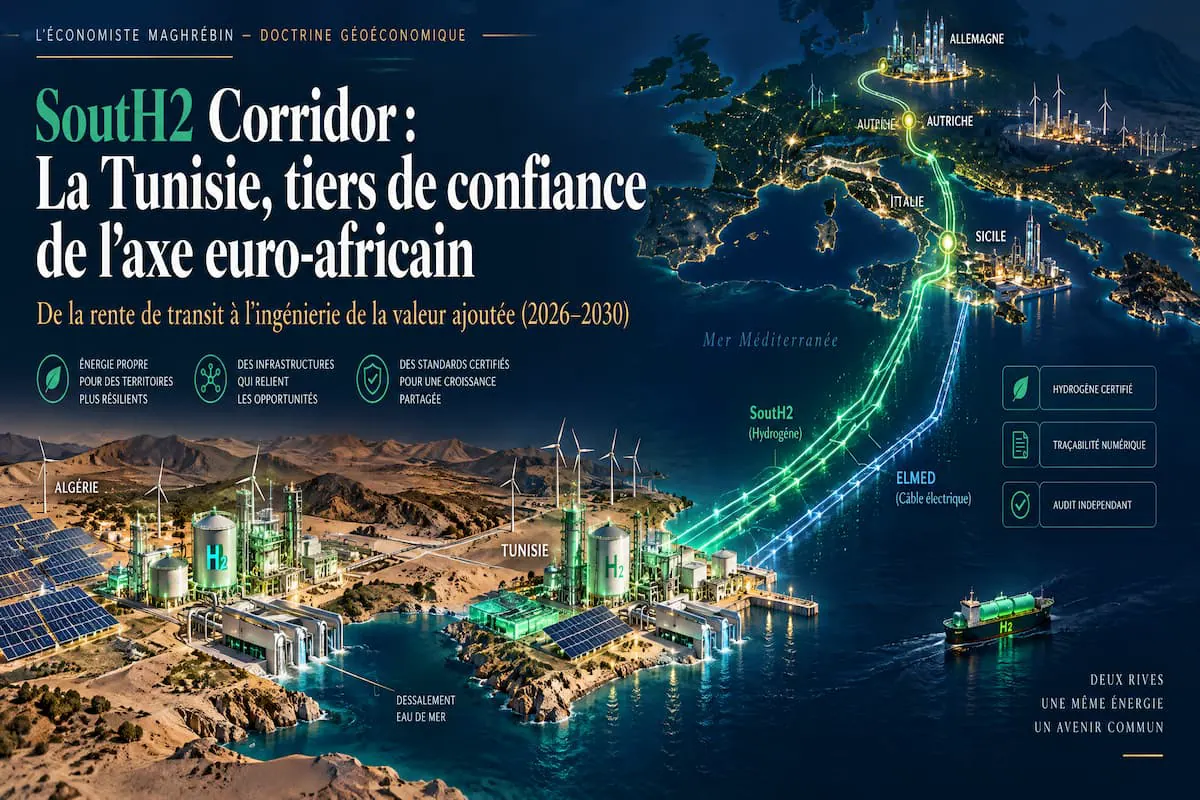
Tunisia is set to play a crucial role in the SoutH2 Corridor, a 3,300 km pipeline aimed at transporting over 4 million tons of green hydrogen per year from North Africa to Central Europe. A recent high-level meeting in Algiers between Tunisian Industry, Mines, and Energy Minister Slah Zouari, Algerian President Abdelmadjid Tebboune, and energy ministers from Austria, Germany, and Italy marked a significant step towards making this project a reality. The meeting demonstrated the commitment of all parties to move forward with the project, which is expected to become a major artery for green energy transportation.
The SoutH2 Corridor project has the potential to transform Tunisia's positioning from a mere transit country to a major player in the green hydrogen value chain. To achieve this, Tunisia must ensure that it does not merely collect passive transit fees but instead becomes a co-owner of the industrial and technological aspects of the project. This requires a strategic approach that balances sovereignty, certification rigor, and execution speed. The Tunisian government must prioritize industrial integration, including investments in desalination plants powered by renewable energy and technology transfer for electrolyzer assembly and maintenance.
One of the critical aspects of the project is ensuring that the production of green hydrogen does not strain Tunisia's water resources. The country must implement a counterproposal that includes investments in desalination plants powered by renewable energy, guaranteeing that the production of hydrogen does not affect the country's water tables. Additionally, Tunisia must position itself as a hub for conformity and digital certification, leveraging its robust banking and digital sectors to provide auditing and certification services for the green hydrogen produced.
The European market for decarbonized energy is subject to stringent regulatory requirements, including strict carbon footprint tracking and sustainability criteria. Tunisia can capitalize on its expertise in these areas to become a key player in the green hydrogen market. By coupling its energy infrastructure with digitalization, including industrial IoT, secure registers, and predictive AI, Tunisia can provide high-value-added services that neither raw suppliers nor final buyers can assume alone.
Financing the project is a significant challenge, with estimates suggesting that investments will be in the billions of euros. However, Tunisia can explore blended finance options and public-private partnerships, backed by guarantees from European financial institutions such as the European Investment Bank and the European Bank for Reconstruction and Development. The Tunisian banking sector must organize itself to act as a co-arranger of these complex financings, ensuring that returns on investment and cash flows benefit the national financial system.
Despite the potential benefits, the project faces significant administrative hurdles, including lengthy authorization procedures and a lack of a dedicated regulatory framework for green hydrogen. To overcome these challenges, Tunisia must establish a fast-track administrative process, a single investment gateway, and a clear hydrogen code. The presence of high-level ministers from Tunisia, Algeria, Italy, Germany, and Austria at the Algiers meeting demonstrates the political will to push the project forward.
The success of the SoutH2 Corridor project depends on Tunisia's ability to translate diplomatic alliances into concrete regulatory and administrative frameworks. By combining industrial sovereignty, certification rigor, and execution speed, Tunisia can transform its geographical positioning into a major engineering power serving the continent. The project's progress will be closely watched, as it has the potential to set a precedent for future green energy projects in the region.
Key points
- The SoutH2 Corridor project aims to transport over 4 million tons of green hydrogen per year from North Africa to Central Europe via Tunisia and Italy.
- Tunisia must prioritize industrial integration and technology transfer to become a co-owner of the green hydrogen value chain.
- The project faces significant administrative hurdles, including lengthy authorization procedures and a lack of a dedicated regulatory framework for green hydrogen.