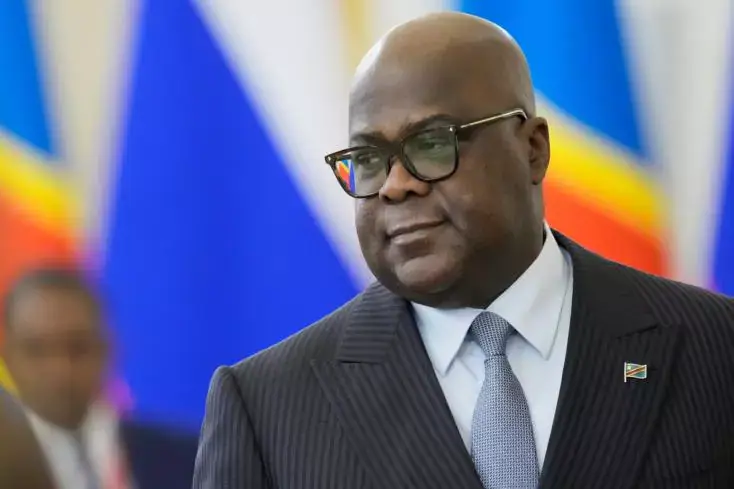
President Felix Tshisekedi of the Democratic Republic of Congo appears determined to pursue a third term in office, despite opposition from his predecessor Joseph Kabila and mounting concerns over the country's stability. The Senate recently adopted a bill outlining the conditions for a referendum, which could potentially pave the way for a new constitution and Tshisekedi's bid for a third term. This move has sparked concerns among critics, who argue that it could exacerbate the country's existing challenges.
Tshisekedi's determination to seek a third term comes amid a multidimensional crisis in DR Congo, including an ongoing Ebola epidemic, sociopolitical tensions, and a security crisis in the east. His predecessor, Joseph Kabila, has threatened to oppose the move, and has formed a new politico-military group, the Front for the Refoundation of the Nation (FRN). Despite these challenges, Tshisekedi has pushed forward with his plans, and the Senate's adoption of the bill has cleared a major hurdle.
Critics argue that Tshisekedi's bid for a third term is driven by a desire for personal gain, rather than a genuine interest in serving the country. They point out that the president and his allies have failed to address the country's most pressing challenges, including poverty, lack of infrastructure, and limited access to basic services. The opposition has also accused Tshisekedi of attempting to cling to power, despite the country's constitution limiting presidential terms.
The international community has expressed concerns over the developments in DR Congo, with some arguing that Tshisekedi's bid for a third term could destabilize the region. The African Union and other regional organizations have called for calm and urged the government to respect the country's constitution. However, Tshisekedi's supporters argue that the president has a right to seek re-election, and that the constitution can be amended to allow for a third term.
The debate over Tshisekedi's third term bid has also highlighted the role of the country's elite, including politicians and parliamentarians, who have been accused of prioritizing their own interests over the needs of the country. Critics argue that these individuals are complicit in Tshisekedi's bid for a third term, and that they will be held accountable for their actions in the future.
The country's history has shown that prolonged stays in power can be detrimental to the country's development. Since independence, DR Congo has had only two presidents, Mobutu and Kabila, who have ruled for a combined 48 years. The country's prolonged periods of authoritarian rule have hindered its development and led to widespread poverty and instability.
As Tshisekedi's bid for a third term continues to move forward, concerns are growing over the potential consequences for the country. The international community is watching closely, and there are fears that the move could lead to further instability and conflict in the region.
Key points
- Tshisekedi's third term bid sparks concerns over DR Congo's stability and constitutional term limits.
- The move has been opposed by Tshisekedi's predecessor, Joseph Kabila, and has sparked concerns among critics.
- The country's elite have been accused of prioritizing their own interests over the needs of the country.