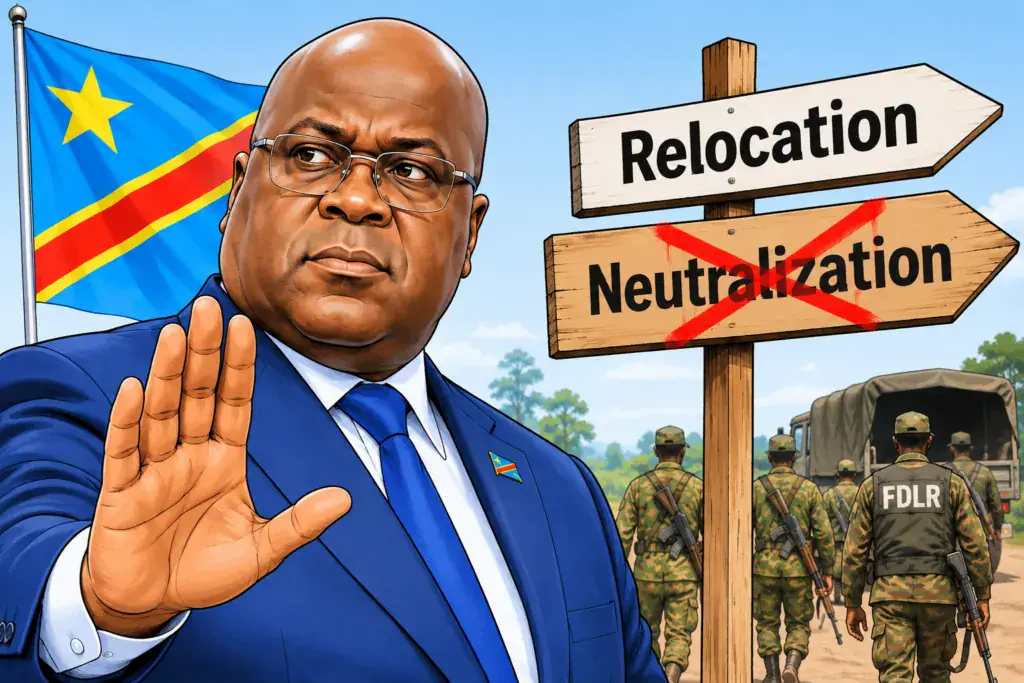
President Félix Tshisekedi's recent remarks on the FDLR have sparked concerns about the Democratic Republic of Congo's commitment to the Washington Peace Agreement. During an exchange with the Congolese diaspora in Russia on October 30, Tshisekedi stated that his government is regrouping FDLR members in Kitona, with plans to transfer them to another country. This move has raised questions about why Kinshasa is opting for relocation instead of fulfilling its commitment to neutralize the group.
The Washington Peace Agreement requires concrete security measures to address the threat posed by the FDLR, not relocation. The agreement aims to dismantle the organization, eliminate its military capabilities, and address its genocidal ideology. Relocating FDLR members from one location to another or transferring them to another country's territory does not achieve these goals. Instead, it merely shifts the problem elsewhere, potentially creating new security concerns.
Contradictions within the Congolese leadership have added to the confusion. Foreign Minister Thérèse Kayikwamba Wagner recently stated that the DRC could not neutralize the FDLR because its members were operating in territories controlled by M23. However, President Tshisekedi's announcement that his government has regrouped FDLR members in Kitona seems to contradict this claim. It remains unclear which version the international community should believe.
The FDLR's presence and activities in eastern DRC are well-documented, and neutralizing the group is essential for regional stability. President Tshisekedi has accused Rwanda of using the FDLR as a pretext for its security concerns and involvement in eastern DRC. However, if the FDLR is merely a pretext, it is unclear why Tshisekedi's government would resist neutralizing the group, which would remove that pretext.
The United States played a central role in facilitating the Washington Agreement, and its credibility now depends on ensuring that commitments made by the signatories translate into measurable action. The international community is seeking answers on the status of FDLR members in Kitona, their disarmament, and the framework for transferring them abroad. The US must demand concrete actions from Kinshasa to address the FDLR threat.
The DRC government owes the international community a consistent explanation for its actions regarding the FDLR. The group's neutralization is not a favor to Rwanda but a security obligation and an essential step toward lasting regional stability. It remains to be seen whether Kinshasa has the political will to take concrete actions against the FDLR.
The international community will be watching closely to see how the situation unfolds. The question is no longer what Kinshasa is expected to do but whether it has the political will to do it. The US and other stakeholders must ensure that commitments made by the DRC government translate into measurable action to address the FDLR threat.
Key points
- The DRC government's plan to relocate FDLR members instead of neutralizing them raises concerns about its commitment to the Washington Peace Agreement.
- The FDLR's neutralization is essential for regional stability, and the DRC government must take concrete actions to address the threat.
- The international community, particularly the US, must demand concrete actions from Kinshasa to address the FDLR threat and ensure that commitments made by the DRC government translate into measurable action.