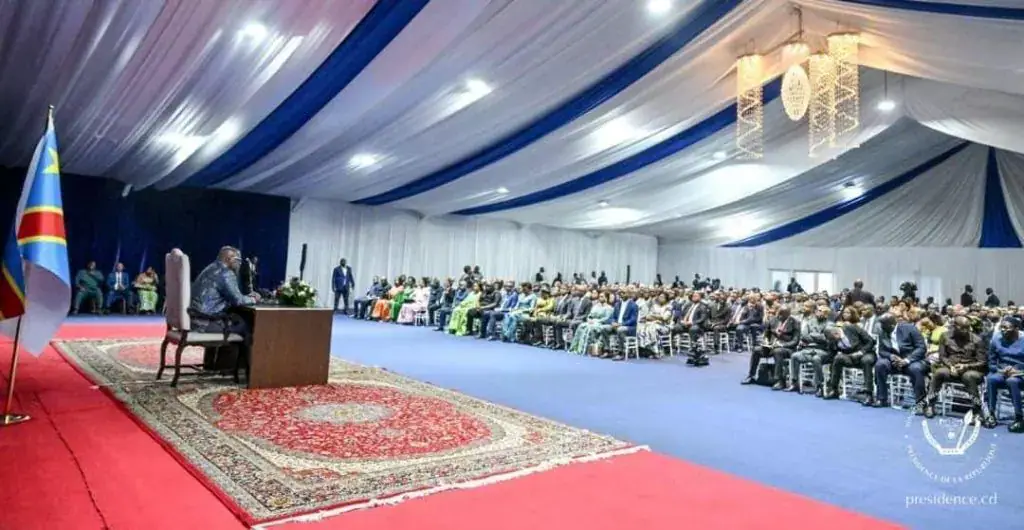
President Felix Tshisekedi of the Democratic Republic of the Congo has announced plans to launch a national dialogue aimed at addressing the country's persistent security crisis and promoting national cohesion. The dialogue, which is set to begin next week, will bring together various stakeholders to discuss the country's challenges and find solutions. Tshisekedi has designated two co-facilitators from the African Union to accompany the process. The initiative has been met with skepticism by some, who question the government's intentions.
The national dialogue is seen as a crucial step towards restoring peace and stability in the country, particularly in the eastern region where conflict has been ongoing. Tshisekedi has assured that the dialogue will not be used to extend his mandate, but rather to promote national cohesion and address the country's challenges. The president has also appealed to his supporters not to confuse the dialogue with his personal political ambitions. The initiative has been welcomed by some, who see it as an opportunity for the government to engage with various stakeholders and find solutions to the country's problems.
The national dialogue will be coordinated by a national coordination team, which will be responsible for overseeing the process and ensuring its success. The team will be composed of representatives from various sectors of society, including politics, civil society, and the private sector. The dialogue will also be supported by international partners, including the African Union. The process is expected to be inclusive, with representatives from various regions and sectors of society participating.
However, some critics have raised concerns about the credibility of the dialogue, citing the need for greater transparency and inclusivity. They argue that the dialogue must be representative of various stakeholders and that its outcomes must be tangible and meaningful. The opposition has also expressed concerns about the government's intentions, citing the recent adoption of a law that allows for a referendum to be held on constitutional changes.
The law, which was adopted by the National Assembly on October 23, has sparked controversy, with some arguing that it could be used to extend Tshisekedi's mandate or alter the constitution. The opposition has criticized the law, citing concerns about the potential for abuse of power and the erosion of democratic institutions. Christian Mwando, a member of the opposition, has denounced the initiative as an attempt to bypass the constitution and undermine democratic guarantees.
The national dialogue is taking place against the backdrop of a persistent security crisis in the eastern region of the country. The crisis has resulted in significant humanitarian suffering and displacement of populations. Tshisekedi has called on parliamentarians to support the dialogue and work towards finding solutions to the country's challenges. The success of the dialogue will depend on its ability to address the country's security crisis and promote national cohesion.
The outcome of the national dialogue is uncertain, but it is clear that it will have significant implications for the country's future. The government's commitment to the dialogue and its willingness to engage with various stakeholders will be crucial in determining its success. The international community is also watching closely, with many partners expressing support for the initiative and urging the government to ensure its credibility and inclusivity.
Key points
- The national dialogue aims to address the security crisis and promote national cohesion in DR Congo.
- The initiative has been met with skepticism by some, who question the government's intentions.
- The dialogue's success will depend on its ability to be inclusive and address the country's challenges.