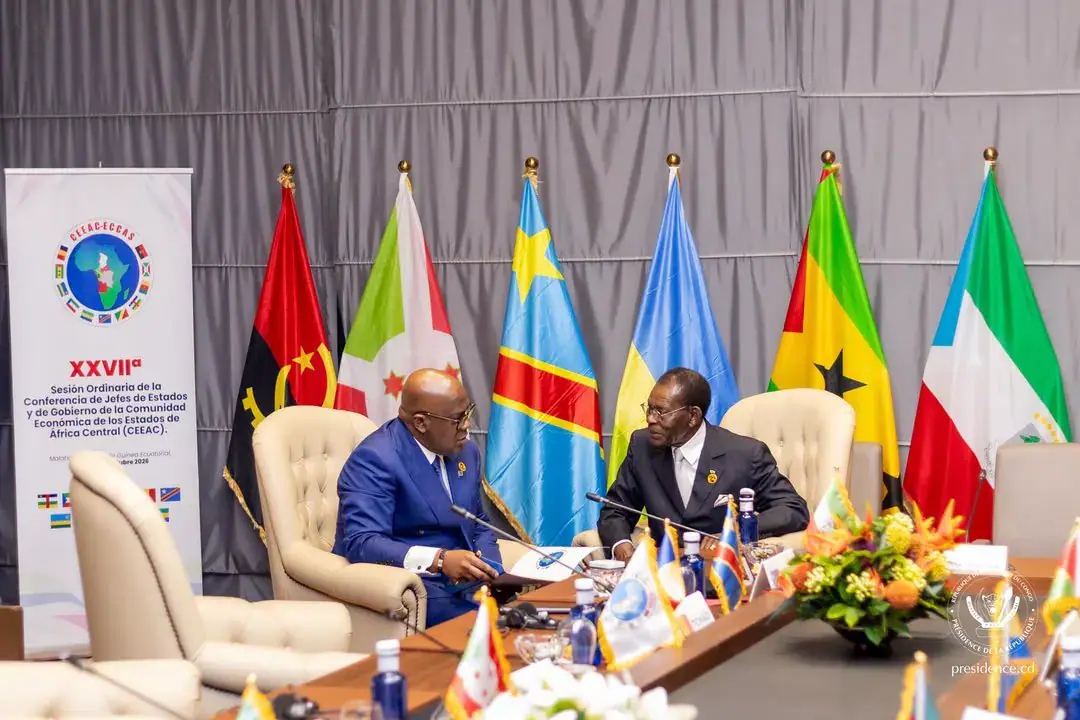
President Félix Tshisekedi of the Democratic Republic of Congo has secured fresh regional backing for his efforts to restore peace and security in the country's eastern provinces. At the 27th ECCAS Summit in Equatorial Guinea, Central African leaders reaffirmed their solidarity with the DR Congo and called for increased international support to address the worsening security and humanitarian crisis. They expressed deep concern over Rwandan aggression against the DR Congo and appealed to the African Union and the international community for strengthened political and financial support.
The regional leaders' endorsement came after Tshisekedi drew attention to the gravity of the security, humanitarian, and health challenges confronting eastern Congo. According to a statement released by the Congolese presidency, the leaders emphasized the need for continued de-escalation and the effective implementation of United Nations Security Council Resolution 2773. The resolution, adopted unanimously on February 21, 2025, demands an end to M23 hostilities, the withdrawal of Rwandan forces from Congolese territory, and the cessation of Kigali's military support for the rebel movement.
The summit also acknowledged progress made by the Congolese government in neutralizing the Democratic Forces for the Liberation of Rwanda (FDLR), an armed group whose presence in eastern Congo has long been cited by Kigali as a major security concern. Regional leaders welcomed initiatives undertaken by Congolese authorities to facilitate the disarmament, demobilization, and voluntary repatriation of combatants in accordance with existing commitments and agreed mechanisms.
One of the most consequential outcomes of the summit was the formal endorsement of Rwanda's withdrawal from ECCAS, bringing a prolonged diplomatic dispute within the regional organization to a new stage. Rwanda announced its departure in June 2025, following the 26th ECCAS summit in Malabo, where regional leaders condemned Rwanda's actions in eastern Congo and reaffirmed their solidarity with Kinshasa.
Rwanda's departure represents a significant setback for regional integration at a time when cross-border security cooperation is particularly critical. It also exposes the challenges facing African regional institutions in reconciling competing national interests, resolving conflicts involving member states, and preserving regional cohesion.
For Tshisekedi, the Equatorial Guinea summit secured renewed diplomatic backing from Central African leaders. The greater challenge, however, remains translating regional solidarity and international commitments into tangible improvements on the ground, restoring security, facilitating the return of displaced populations, and creating conditions for sustainable peace in eastern Congo.
The conflict in eastern Congo has displaced communities, disrupted economic activities, undermined healthcare delivery, and placed enormous pressure on humanitarian agencies. Tshisekedi's appeal underscored the need for a coordinated international response that addresses both the security threats and the suffering of civilians. The renewed endorsement of UN Security Council Resolution 2773 reinforces diplomatic pressure for the implementation of existing peace commitments.
Key points
- Central African leaders call for increased international support to address the security and humanitarian crisis in eastern Congo.
- Regional leaders endorse Rwanda's withdrawal from ECCAS, a significant setback for regional integration.
- Tshisekedi secures renewed diplomatic backing for efforts to restore peace and security in eastern Congo.
Reporting sources
- Tshisekedi Secures Fresh Regional Backing Over Eastern Congo Crisis · Pan African Visions