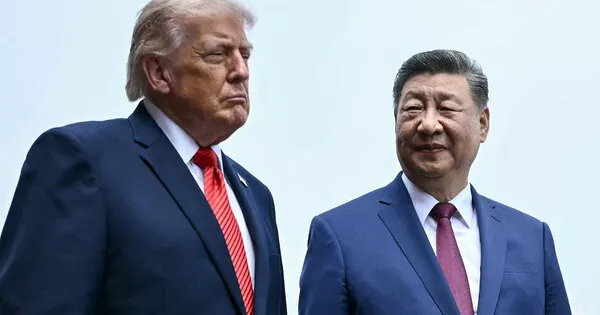
The leaders of the world's two most powerful countries, US President Donald Trump and Chinese Chairman Xi Jinping, met in Washington, DC, from 23-25 September 2026. The summit between the two leaders was much anticipated, but the results were underwhelming and did nothing to diminish the intersecting trajectories of the two nations. Despite this, some view it as a positive that the two countries remain committed to engagement.
The meeting highlighted several problem areas, including Taiwan, which was simply kicked down the road yet again. There were also notable moments, such as when US Ambassador to China David Perdue revealed that Trump offered to sell weapons to Beijing. This move has raised concerns, with Ryan Hass, Director of the US-based Brookings Institution's John L. Thornton China Center, stating that it will be unsettling to American partners.
Trump is withholding large packages of arms sales to democratic Taiwan, using them as a bargaining chip with China. This move has not yielded any results, with Drew Thompson, a Senior Fellow at the S. Rajaratnam School of International Studies in Singapore, believing that Trump will not approve the next arms sales notification to Taiwan until early 2027.
The statements put out by the two governments after their summit indicated their different priorities, as each jostled to put a gloss on the proceedings to prove they had gained the upper hand. Beijing's statement mentioned the fact that the two parties "reached eight deliverables and understandings", including building a constructive China-US relationship of strategic stability.
However, there are concerns about the interpretation of certain terms, such as "reciprocity", which has a different nuance in Mandarin. The two countries also praised the Sino-US economic and trade consultation mechanism, as well as the Board of Trade and a reduction in tariffs. Additionally, they praised "visible outcomes" in counter-narcotics efforts.
The final two points listed by Beijing encompassed the establishment of the China-US AI Dialogue to exchange views on risks and benefits related to artificial intelligence, and the lease of two pandas to Atlanta Zoo. However, some agreements, such as the memorandum of understanding on crisis communication and prevention between the two militaries, already exist.
The White House fact sheet did not mention this agreement, and one US official even said the issue was never discussed during the summit. The USA also called for trilateral arms control negotiations between the USA, Russia and China, something again left unmentioned by China. Experts have expressed skepticism about the prospects of such negotiations.
Key points
- The Trump-Xi summit did not create breakthroughs or outcomes, and was instead long on ceremony and short on substance.
- The two countries remain committed to engagement, but problem areas such as Taiwan were not addressed.
- The summit highlighted the different priorities and interpretations of the two governments.