US President Donald Trump has weighed in on the recent school protests in France, sparking controversy with his remarks. On his social media platform, Truth Social, Trump wrote that the protests have nothing to do with schools, but rather with the desire of Islam to control a country that was once great. This statement has raised questions among his followers about the accuracy of his claims and whether they reflect the reality on the ground in France.
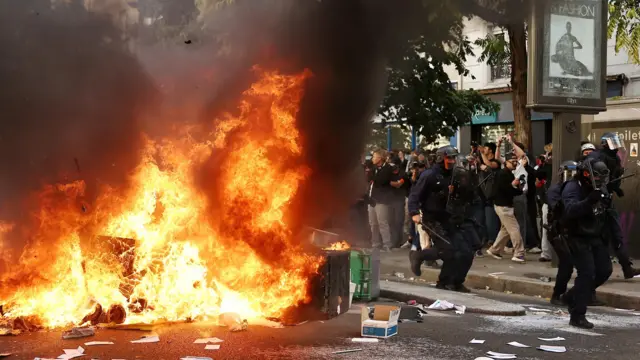
The protests in France have been gaining momentum in recent days, with thousands of students and teachers taking to the streets to express their concerns about various issues. While the specific grievances of the protesters are varied, they appear to be largely focused on education policy and the government's handling of the COVID-19 pandemic. Trump's comments have added a new layer of complexity to the debate, with some critics accusing him of attempting to exploit the situation for his own political purposes.
Trump's remarks have also sparked a strong reaction in Morocco, where some have taken to social media to express their outrage and disappointment. The Moroccan government has not officially responded to Trump's comments, but some officials have privately expressed their concerns about the potential impact on bilateral relations. The incident highlights the complex and often fraught nature of the relationship between Morocco and France, which has a significant Moroccan diaspora community.
The French government has been grappling with a range of challenges in recent months, including protests over pension reform, COVID-19 restrictions, and concerns about terrorism and national security. The protests in schools and universities have added to the sense of turmoil and uncertainty, with some critics accusing the government of mishandling the situation. The government has promised to engage in dialogue with protesters and address their concerns, but it remains to be seen whether this will be enough to calm the situation.
Trump's comments have also sparked a wider debate about the role of Islam in French society and the challenges of integrating Muslim communities into the country's social and cultural fabric. Some have argued that Trump's remarks reflect a broader Islamophobic sentiment in some parts of the West, while others have defended his right to express his opinions. The debate is likely to continue in the coming days and weeks, with implications for France, Morocco, and the wider international community.
The incident has also raised questions about the extent to which Trump's comments reflect his own personal views and biases, as well as the broader ideological currents that shape his approach to politics. Some have noted that Trump's remarks are consistent with his previous statements on Islam and immigration, which have often been characterized as divisive and inflammatory. Others have argued that Trump's comments are a reflection of a deeper cultural and philosophical divide between the US and Europe.
In the aftermath of Trump's comments, it remains to be seen how the situation in France will evolve and what implications this will have for the country, the region, and the wider international community. One thing is clear, however: Trump's remarks have added a new layer of complexity to an already fraught and complex situation, and it will be important to monitor developments closely in the coming days and weeks.
Key points
- Trump's comments have sparked controversy and debate in Morocco and France.
- The protests in France are largely focused on education policy and the government's handling of the COVID-19 pandemic.
- Trump's remarks reflect a broader debate about the role of Islam in French society and the challenges of integrating Muslim communities.