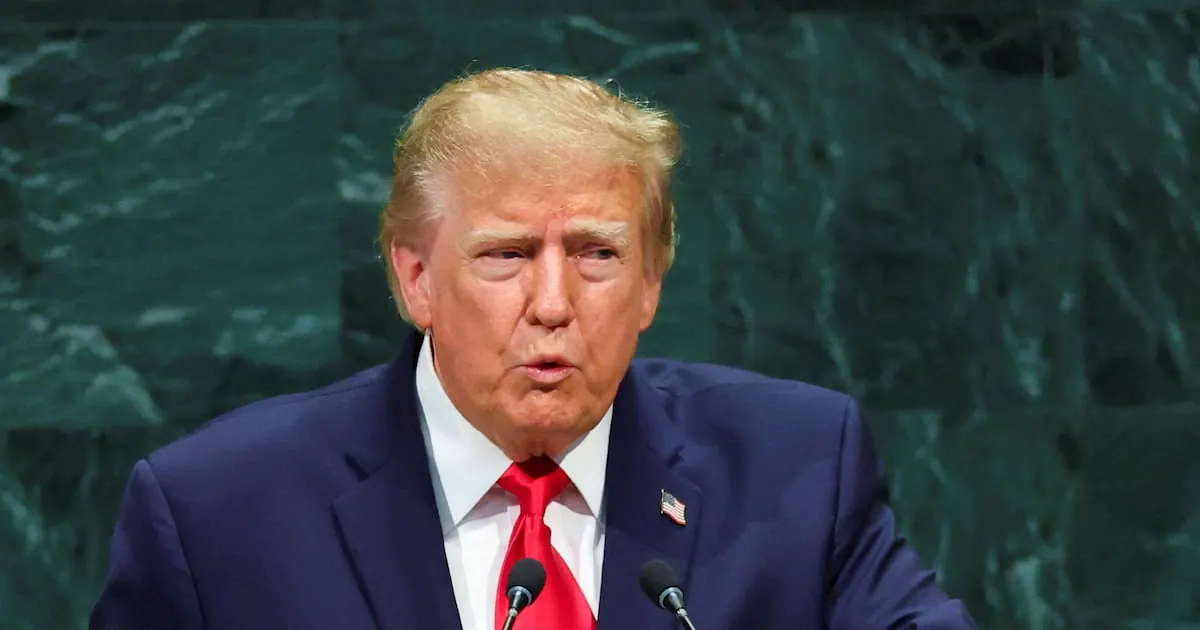
US President Donald Trump has warned that he could "annihilate" Iran if no deal is reached to end the conflict between the two nations. In his speech to the UN General Assembly, Trump argued that the war with Iran had prevented Tehran from obtaining a nuclear weapon. He also called on other nations to join the US in isolating Iran economically to force it to the negotiating table. The speech marked the latest justification Trump has offered for the war with Iran.
Trump predicted that his administration would strike a peace deal with Iran following the November 3 US midterm elections. He posed a series of questions about the potential outcomes of the conflict, including whether he would "drive them into hell with no chance of survival and no hope of future greatness for generations." The US-Israeli war against Iran has been consequential, driving up fuel prices globally and dragging down Trump's approval ratings. A Reuters/Ipsos poll on Monday showed Trump's approval rating falling to an all-time low of 32%.
The speech kicked off a day of high-level diplomacy at the United Nations, where Trump was due to meet more than a dozen world leaders. The meetings will focus on issues including the war in the Middle East and Ukraine, which have tested Trump's foreign policy agenda. Trump's schedule included meetings with British Prime Minister Boris Johnson, Ukrainian President Volodymyr Zelenskiy, and Venezuelan interim leader Juan Guaido, among others.
Trump's comments on Iran were met with protests outside the UN headquarters, where dozens of anti-Iranian government demonstrators gathered. Some held signs calling for freedom and democracy and decrying dictatorship. The protesters expressed concerns about the human rights situation in Iran and the country's nuclear programme.
The US-Israeli war against Iran has been driven by a range of factors, including Tehran's nuclear programme, its support for regional proxy groups, and the prospect of regime change. Iran has consistently denied seeking to develop nuclear weapons. The conflict has also had significant economic implications, including driving up fuel prices globally.
Trump's meeting with Gulf leaders, including those from the United Arab Emirates, Saudi Arabia, Oman, Bahrain, Kuwait, and Qatar, will focus on issues including the recent advances of the Houthis, Iran-backed militants who have captured wide swathes of Yemen. The Houthis have also attacked US ally Saudi Arabia and threatened shipping through the strategic Bab el-Mandab Strait.
Trump's foreign policy agenda has been marked by controversy, including his handling of the conflict in Ukraine and his comments on climate policy and mass migration. His meeting with Danish Prime Minister Mette Frederiksen and Greenland's Prime Minister Jens-Frederik Nielsen will focus on issues including a potential accord to increase US military presence on Greenland while limiting that of geopolitical adversaries.
Key points
- Trump's approval rating has fallen to an all-time low of 32%.
- The US-Israeli war against Iran has driven up fuel prices globally.
- Trump will meet with over a dozen world leaders during his visit to the UN.